
Welcome to the February edition of EED News.
February has brought both encouraging signs of civic resilience and sobering reminders of the fragility of democratic progress across EED's regions of work. From anti-corruption battles in the Western Balkans to electoral preparedness in the South Caucasus, EED's partners continue to hold the line in testing conditions.
EED continues to stand with those who defend democratic values across the European Neighbourhood and beyond – in the spaces where that work is hardest and most needed.
The following provides an overview of some of the regions where EED works.
This month marked four years since Russia's full-scale invasion of Ukraine – a sobering anniversary that underscored both the immense human cost of the war and the extraordinary resilience of Ukrainian civil society and independent media.
On 25 February 2022, a day after the Russian military invasion of Ukraine, the EED Executive Committee approved an emergency assistance programme to support Ukrainian partners, resulting in assistance for 65 initiatives during the first eight weeks of the war.
EED also took the exceptional measure of opening, a few days after the full-scale war began, the Centre for Ukrainian Activists (CUA) in Przemyśl on the Polish–Ukrainian border, where millions of war refugees were crossing the border between the terror of war and safety.
The Centre provided space and capacity for activists and journalists to continue their work in a safe environment once they had crossed the border. The majority of them were women activists and journalists, often travelling with children.
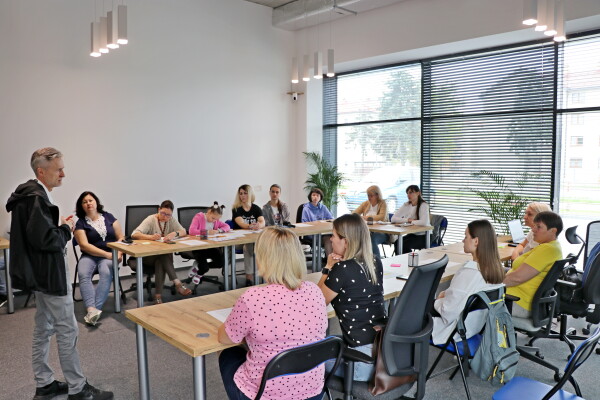
CUA Przemyśl 2022
EED's partners continue to operate under extreme pressure, often at great personal risk. Their work — spanning investigative journalism, civic mobilisation, human rights documentation, and community support — represents Ukraine's democratic infrastructure in conditions where formal democratic processes remain constrained. EED remains committed to sustaining this vital ecosystem, including in temporarily-occupied territories and frontline regions that receive insufficient attention from the broader donor community.
On 24 February, EED shared messages of EED’s partners across social media, ensuring that European audiences hear directly from those carrying this work forward on the ground, which can be viewed here and below.
Albania is navigating a significant test of its anti-corruption institutions. The indictment of former Deputy Prime Minister Belinda Balluku on corruption charges related to road tenders worth over €50 million has triggered a political standoff between the government and the Special Court on Anti-Corruption and Organised Crime (SPAK). Prime Minister Edi Rama initially resisted the court-ordered suspension, appealing to the Constitutional Court, which ultimately upheld SPAK's measure. In Parliament, the process of lifting Balluku's immunity continues to be deliberately delayed.
EED partners have responded swiftly. Qëndresa Qytetare organised a creative protest outside the Albanian Parliament demanding action. Together with Grupi Ata and supported by a broad coalition of civil society organisations, Qëndresa Qytetare jointly appealed to Parliament, calling for the rule of law to be upheld. EED media partner Citizens.al provided both news coverage and in-depth analysis of the unfolding situation. The case has attracted European attention: during his visit to Albania on 18 February, David McAllister MEP, Chair of the European Parliament's Committee on Foreign Affairs and of EED's Board of Governors, described the Balluku case as a critical test for Albania's fight against corruption.
Ahead of Armenia's parliamentary elections on 7 June, EED co-hosted a donor coordination meeting in Yerevan on 19 February alongside the Media Initiatives Centre, National Endowment for Democracy, and Prague Civil Society Centre. The meeting focused on the needs of civil society and independent media both before and after the elections. Key priorities identified included longer-term strategic support, safe spaces for cross-sector dialogue, and sustained attention to marginalised communities. Participants also flagged the growing risks of Domestic Information Manipulation and Interference (DIMI) alongside external threats (FIMI).
Restart Foundation - a driving force for student activism in Armenia, and EED grantee has published new research on the factors shaping youth electoral behaviour, finding that young Armenians – a numerically significant but deeply disengaged electoral group – are most effectively reached through in-person activities and trust-based social networks rather than digital outreach alone.
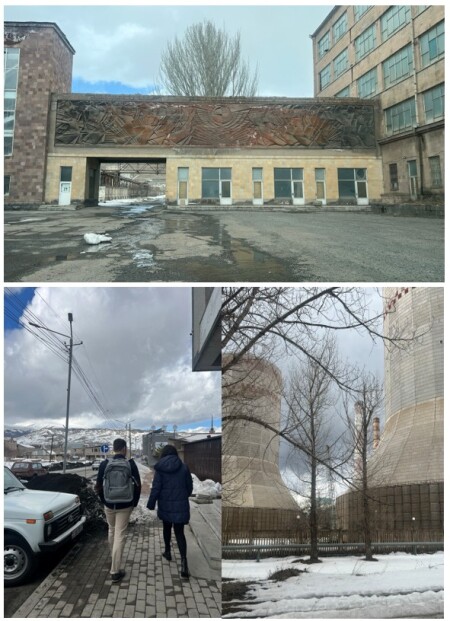
In February EED staff alongside EED grantee Shushanik Harutyunyan, head of the Urban Imagination Sociological Research Laboratory NGO, visited Hrazdan – a post-industrial town in Armenia that previously housed 14 large-scale factories, now almost fully abandoned. The town is struggling to recover from industrial collapse, with its social fabric deeply affected. EED's supported initiative seeks to promote urban democracy by engaging researchers, residents, young people, civil society organisations, and local governance bodies in reimagining the city's future and reconnecting residents with their heritage. The visit made clear that the absence of public spaces and independent, non-state venues is a significant constraint on civic activism in communities such as Hrazdan.
On the fourth anniversary of Russia’s the full-scale invasion of Ukraine EED shared messages of EED’s partners across social media, ensuring that European audiences hear directly from those carrying this work forward on the ground.