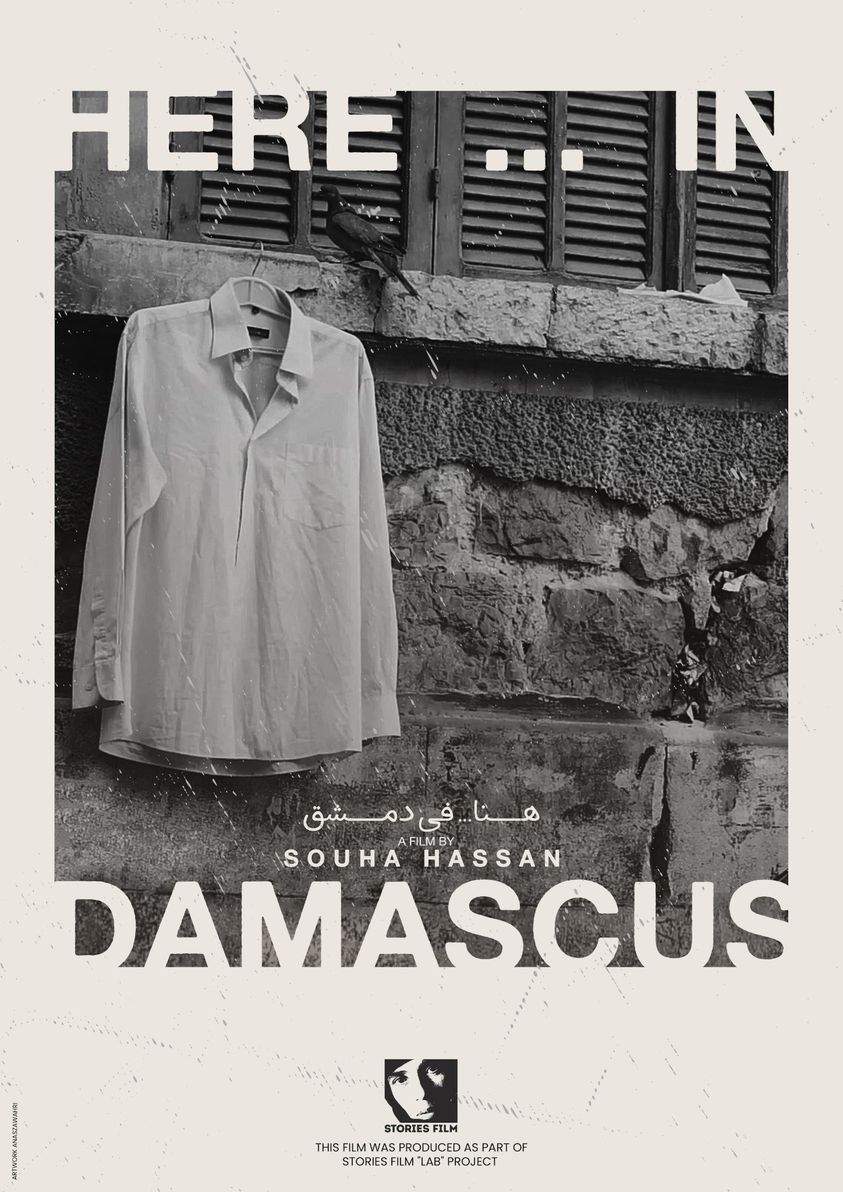
Stories Film have built something that didn't exist before: a space where young filmmakers can learn their craft and heal.
Many years ago, at the height of the worst atrocities of the Assad regime, Sasha Ayoub made a decision that would define her life. She would stay in Syria. Despite the isolation and the risks, she wanted to do something helpful in her home. Her passion was documentary cinema, and she believed that passion could make a difference.
In early 2020, when her colleague Reem had to leave Syria, Sasha took over Stories Film Lab, a project Reem had founded just months earlier to provide a space for young potential filmmakers to develop their projects.
Sasha, a freelance film editor, fell in love with the project. “We were helping young filmmakers think outside the box. This was the dream I would have loved to live when I was younger,” she says.
Stories Film filled a void. Syria had never had formal cinema education and after 2011, and the beginning of sanctions, young filmmakers were completely cut off from the world, unable to hear different perspectives or learn from experts abroad.
Stories Film operated from an ancient Damascene house with a courtyard, owned by a former cinema technician who became part of what Sasha describes as their cinematic family. Lebanese mentors travelled to Damascus to work with participants.
Most importantly, Sasha describes the lab as a circle of healing. “Young people gathered to talk about their lives, their struggles, their daily experiences in Damascus. Simply having a safe space to listen to each other became transformative.”
The pilot Stories Film Lab edition, supported by EED funding, ran from 2019 to 2021, continuing during the Covid-19 period when it had to go mainly online.
At that time, cinema production in Syria was almost non-existent. “We were maybe the second entity producing films,” Sasha says. “Without EED funding, we wouldn't have been able to produce the films or establish ourselves on the map of cultural institutions in the region.”
Today, Stories Film Labs, their main annual project, is completing its fourth edition and is about to launch a fifth, with each edition lasting five to six months. This is despite having to stop for a one-year period when they didn’t have enough funding to rent a venue.
During each lab, twelve participants gather with film ideas and work through three parallel tracks. Filmmaker Rami Sabbar leads theoretical sessions on cinema schools, time and space in film, character development, showing films to students and offering philosophical perspectives. Creative writing sessions, initially led by Lebanese filmmaker Rania Rafai and now including a Tunisian mentor, take place in groups and one-on-one. Production writing teaches budgeting, funding plans, and how to navigate the film industry. Throughout, participants meet weekly, even as mentors join remotely on the screen.
Sasha explains that one of the most important parts of writing a film dossier is to understand a director’s intentions.
“That’s the most sensitive thing to work on with a mentor,” she says. “You have to speak about your intentions, and why you’re making a film and why it’s important to you. It can mean confronting difficult things. This is why the place becomes therapeutic. You go back and deal with things.”
Participants leave with complete film dossiers, teasers, and pitching training. They've filmed material, discussed it with the group, and learned how to pitch their projects.
The lab has already had some successes. Despite the challenges of censorship during the Assad years, two films from the first Lab edition were produced that are still touring at international festivals. “High People” by Firas Mohamed about nightlife in Damascus won prizes at the Carthage Film Festival. Three other projects are currently in production.
Sasha believes that the impact of Stories Film Lab goes far beyond individual films. The Labs are now part of an important mutual eco-system of filmmakers, and the circle keeps growing. Former participants show up for every activity the lab announces. They help find venues, solve technical issues, spread news about the lab's work.
According to Sasha, the most remarkable success came last year, when three participants from the first edition approached Ayoub about forming a union.
They wanted to defend filmmakers' rights and sustain Damascus's struggling cinemas, especially Cinema Al-Kindi, recently taken over by the Ministry of Religious Affairs. “It's exactly what we were hoping would happen,” she says.
In today’s post-Assad Syria, Sasha feels relief and concern. The fear of security forces is gone, but there are challenges with the new authorities who have different ideas about cinema
For instance, when the Ministry of Religious Affairs took over the central Al-Kindi cinema, they announced daytime hours would feature educational documentaries teaching morals.
“What cinema means to them is very different from what it means to us,” she says. “We're in a phase of getting to know each other.”
The three-person team are expanding their work, with screenings now planned across Syrian cities and specialised workshops. They are working with lawyers and transitional justice experts. They want to use cinema to open dialogue about difficult subjects.
When asked about her superpower, Sasha answers immediately: “The ability to give things time with the faith that it will work out. I always believe time will be one of the things that will ease things.”
She is clear what keeps her going. “I feel a sense of responsibility. I see how former participants speak about the lab and how it changed them. This gives me motivation to keep going.” The decision she made years ago, to stay and do something helpful, still drives her every day. That and her passion for documentary film.
This article reflects the views of the grantees featured and does not necessarily represent the official opinion of EED.