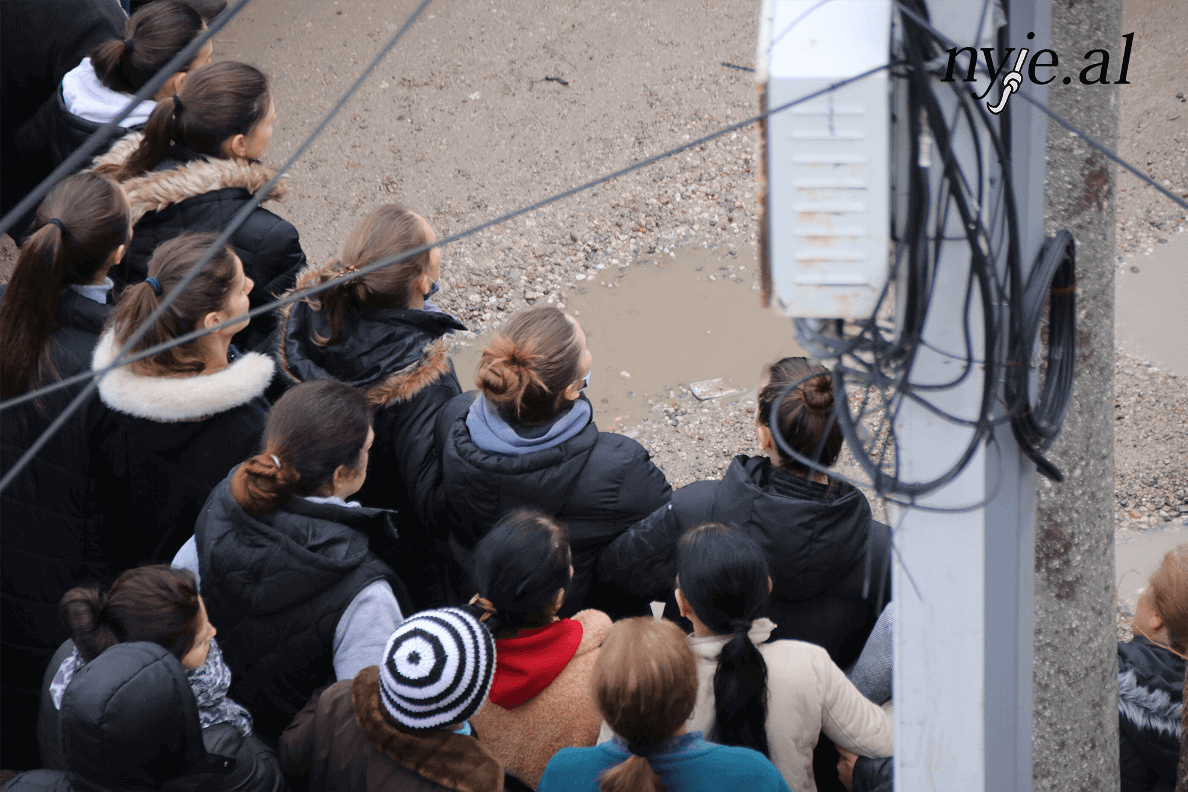
Cover Photo: © NYJE
Albania’s public sphere has long been shaped by a political duopoly and a civil society absorbed into state patronage networks. The media environment is highly constrained, with the independence, diversity and integrity of news eroded by the dependence of most media on non-transparent financing by political and business interests, often reliant on government contracts. In this environment of polluted information and limited political competition, citizens— including youth, the elderly, and marginalised and regional communities—were excluded from democratic life.
This has evolved over the past period as reporting by key independent and investigative media has triggered institutional reactions; citizens have mobilised around issues previously considered untouchable; and new political faces, separate from the traditionally dominant political parties, have entered parliament for the first time in two decades.
What is emerging, with EED’s support, is a media-civic political ecosystem capable of challenging Albania’s entrenched power structures.
A SYSTEM HOLLOWED OUT FROM THE INSIDE
Albania’s media landscape mainly consists of an influential private-sector media owned by a handful of companies with links to the political world. While around 900 portals publish media content every day, around 90 percent of these are controlled by business magnates, political allies, or figures with links to organised crime. Most content is recycled, shallow, or bought. Investigative reporting is confined to a handful of small, often precarious, outlets operating with minimal resources.
Civil society has suffered a similar fate. Large NGOs closely linked to the government and donors dominate the sector, while smaller critical organisations operate at the margins. For many citizens, the sense of political agency has eroded over decades. As one expert described it, “democracy exists as procedure, not as power”.
Political life reflects this hollowness. For over 30 years, Albania has been governed by the same two blocs: the Socialists and the Democrats — operating within structures of clientelism and patronage. While power once alternated between them providing a degree of checks and balances, this pattern has eroded since 2013, as Prime Minister Edi Rama’s Socialist Party has won four consecutive elections.
Elections occur, but they no longer threaten the underlying networks of state capture. The result is a democracy that formally functions but offers few real entry points for citizens, and fewer mechanisms to hold the governing party accountable.
STRENGTHENING INDEPENDENT MEDIA AND CIVIC MOBILISATION
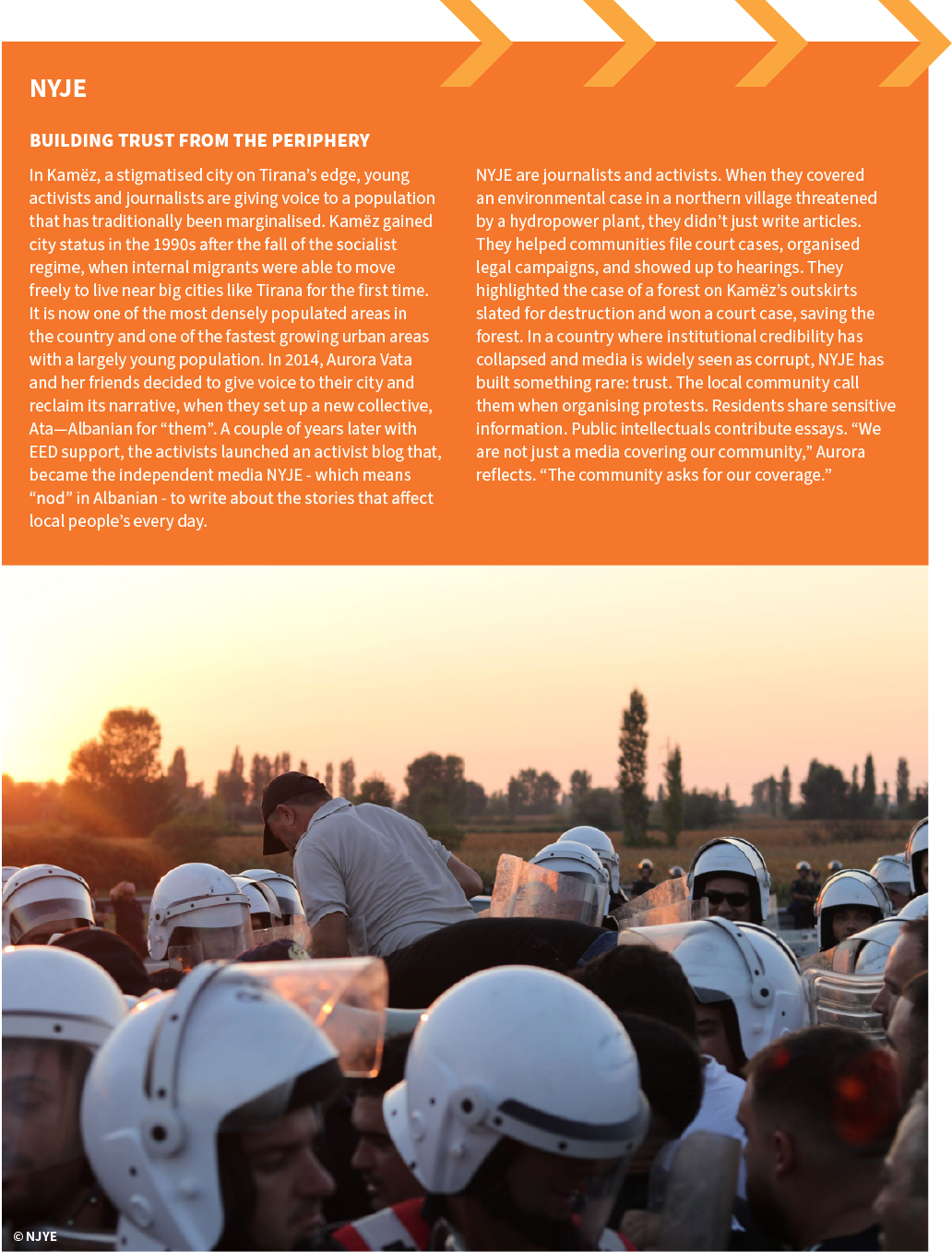
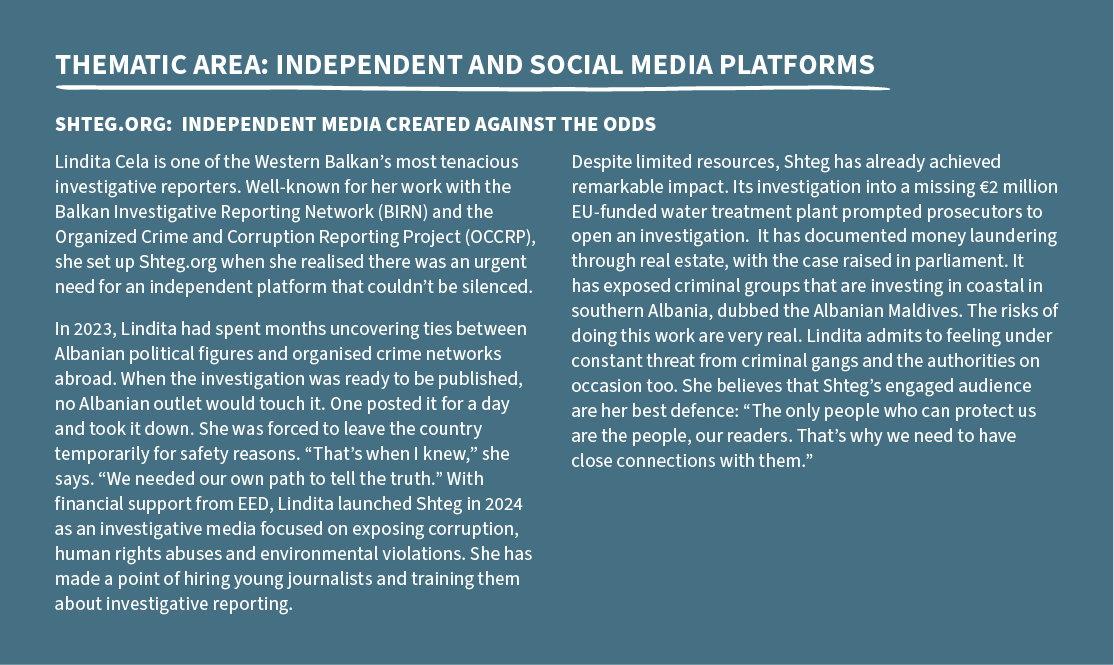
Against this backdrop, a set of independent newsrooms has emerged, many of them supported from their earliest stages by EED. Partner testimony is explicit: “We would not exist as an independent outlet without EED,” say Shteg, an investigative media. “EED’s contribution was substantial for us; it transformed us into a proper media outlet,” say NYJE, a Kamëz based media platform.
This early support enabled the growth of outlets now considered central to Albania’s independent media ecosystem.
Together, these outlets filled some of Albania’s information deserts with fact-based reporting and provided the country with some of its only independent oversight journalism.
MOBILISING CITIZENSGrassroots civic organisations helped mobilise pensioners and workers, mobilising groups that are usually politically inert. For example, hundreds of pensioners, a group often seen as loyal to the ruling party, came out on the streets in protest. “It was the first time the pensioners went out to protest for their interest,” they say. Partners believe that this pressure contributed to a nearly three-fold increase in the government’s annual bonus for pensioners. This is important in a context where pensions are meagre and most rely on remittances from emigrants. It also saw the introduction of free transport for pensioners. These are rare examples of concrete benefits won through citizen mobilisation. |
OPENING POLITICAL SPACEThe combination of investigative reporting and civic organising helped create the conditions for new political forces to emerge and challenge the duopoly of the traditional Socialist–Democratic parties. In some cases, this electoral success was achieved with minimal resources and limited coverage from mainstream broadcasters. The election of new MPs is providing new opportunities for accountability. “For the first time, our reporting is being used inside institutions, not ignored from outside,” one commentator said. |
AN EMERGING DEMOCRATIC ECOSYSTEM
Independent media are producing credible investigations exposing corruption and forcing state institutions to respond. Civic organisations are bringing about change for marginalised groups through collective mobilisation. There is now the potential for political newcomers to use these investigative findings and there are civic demands to challenge entrenched structures from within parliament.
This work marks the foundation of a small and vulnerable nascent democratic ecosystem that is already demonstrating that accountability is possible even in a context of media capture, rampant corruption, and state dominance.
As Citizens.al put it: “You cannot change the big government, but you can change small things. The sum of small changes becomes big change.”
Investigative journalism
Civic mobilisation
Political access
Albania’s democratic stagnation has long been considered entrenched, marked by captured institutions, media monopolies, and limited civic participation. The emergence of an alternative ecosystem – independent journalism, organised citizens, and new political entrants – indicates that change is possible even in highly constrained environments.
For the EU, this shift strengthens the foundations of Albania’s integration process: greater oversight of public institutions, increased citizen voice, and the appearance of political alternatives capable of shaping debate. While still fragile, these developments demonstrate that targeted support to investigative media and civic mobilisation can expand democratic space in settings where formal mechanisms have failed to do so. Albania has now opened the final chapters of EU accession negotiations; however, persistent internal challenges remain – from distorted political representation to state capture, organised crime, and systematic corruption – that continue to obstruct genuine democratic consolidation. The role of civil society and independent journalism in providing for transparency, accountability and rule of law is more vital than ever as Albania implements fundamental reforms in democratic institutions and judicial independence.
These are cornerstones of its EU integration pathway ensuring that these reforms translate into genuine institutional change and provide for continued public trust in the accession process.
This article includes an AI-generated audio version to offer readers an additional way to engage with the content. As the narration is produced using automated voice technology, occasional inaccuracies may occur.