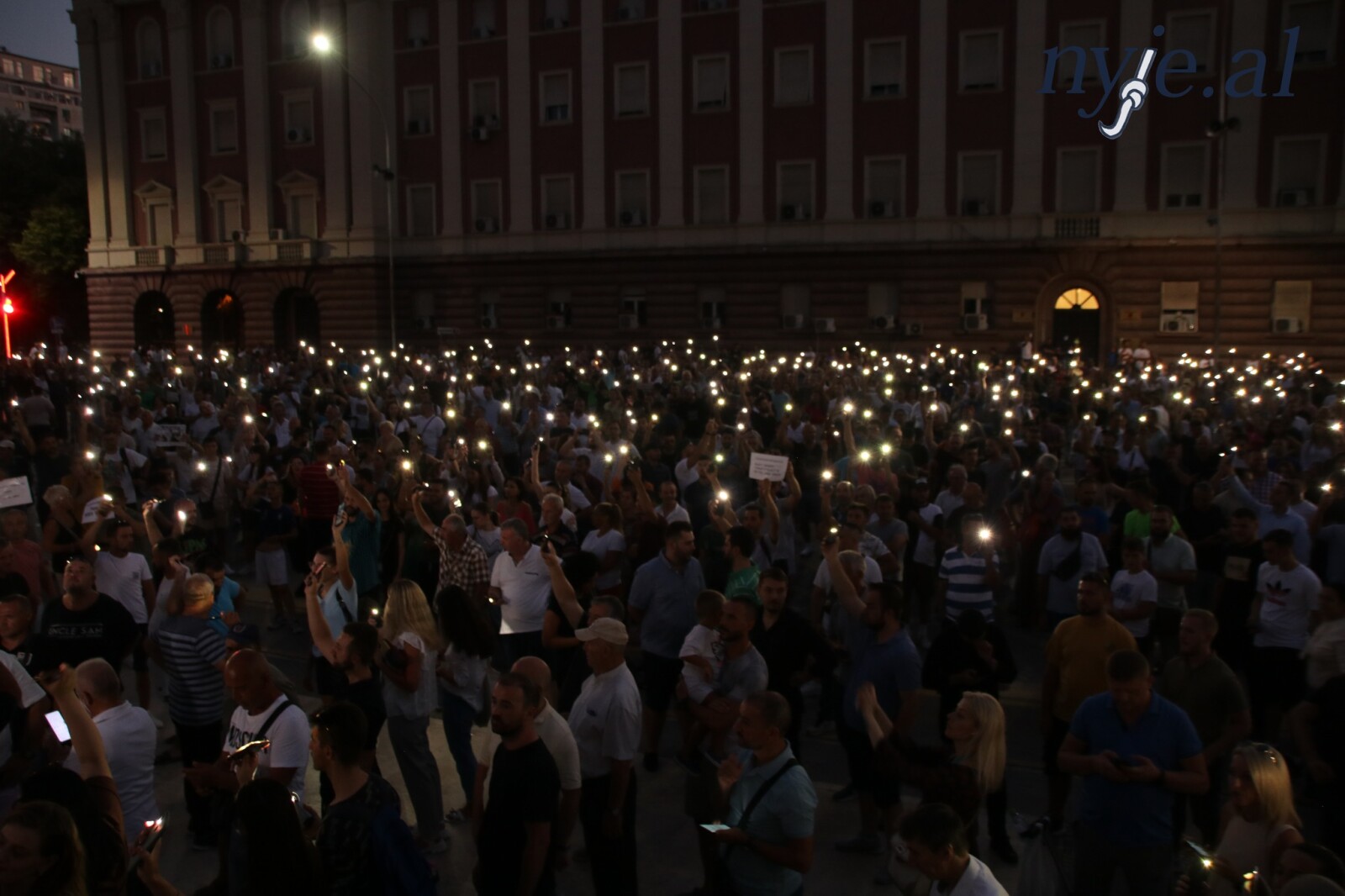
In Kamza, a stigmatised city on Tirana's edge, young activists and journalists are giving voice to a population that has traditionally been marginalised.
Occupiers. Uncultured. Uncivilised. Mountain People. These are all slurs used to describe the people of Kamza, just north of Tirana.
Now a city of 100,000 people, Kamza was built from scratch when Albanians from throughout the country, particularly from the north-eastern regions, fled to the capital seeking better lives, after the collapse of communism in the 1990s. It is one of the most densely populated areas in the country, and it is one of the fastest growing urban areas with a largely young population.
The worst of it, according to Aurora Vata, of the independent media Nyje, is that the people of Kamza had internalised these narratives. “We were ashamed of our origins,” she says.
In 2014, Aurora and her friends decided to reclaim the narrative, when they set up a new collective. They called themselves Ata – Albanian for ‘them’.
“We wanted to build new narratives,” she says. “We wanted to showcase who we really are.”
Ata became known for its work strengthening community mobilisation, particularly among young people, and its focus on pressing socio-economic issues.
Nyje as a platform for local voices
A couple of years after founding Ata, the activists launched an activist blog, that with EED support became the independent media Nyje – which means ‘nod’ in Albanian.
“We wanted to bring attention to the issues of our home – poor infrastructure, corruption, pollution, missing services, the lack of transparency,” she says. “There was a big gap, national media don’t cover local issues, and the only existing media in the city was controlled by the ruling party. There was no platform for the local people’s voices to be heard.”
As Aurora and her colleague, fellow journalist and activist, Ronald Qema, explain, Nyje’s journalism isn’t observed from a distance. It's journalism lived from within.
"We all live in Kamza," says Roland. " We’re writing about our everyday life and about our own community. That shapes how we work and how we report.”
But what makes Nyje unusual isn't just what it covers, but how it covers these stories. “We meet with people, we listen to their stories, we take notes, we photograph them. We tell their stories,” he says.
Activists and journalists
But Nyje is far more than just a media outlet. “We are both activists and journalists,” says Aurora.
Aurora, for example, has a background in law. Others in the collective have studied sociology, law, politics, visual anthropology, journalism and urban planning. They bring this knowledge to their work.
For example, when they covered an environmental case in a northern village threatened by a hydropower plant, they didn't just write articles. They helped communities file court cases, organised legal campaigns, and showed up to hearings.
When they documented a forest in Laknas on Kamza's outskirts slated for destruction, they didn't stop at publishing the story. They went to court, providing legal assistance to the local community. They won and the forest was saved.
It is a stance that has made them enemies. Relations with the Kamza municipality have been strained under right and left-wing administrations. The local authorities have systematically obstructed cooperation with the activities. Freedom of information requests go unanswered for weeks, then return incomplete. Now, the Ata group activists have been banned entirely from municipal council meetings. When they sued the municipality for transparency violations, they won, but officials still don't comply.
Nyje is also one of the few media to cover events on pro-Palestine demonstrations in Tirana, when other media stayed silent.
There are coordinated campaigns to discredit their work. Paid journalists appear on prime-time TV programmes to counter Nyje's environmental investigations. Activists they've worked with are sued for defamation.
In April, just before Albania's elections, Roland’s personal social media account was hacked, and an ISIS image was posted. Nyje’s social media was also attacked.
But both Roland and Aurora believe that these attacks show that Nyje is succeeding. When powerful interests spend money to silence you, it's because you're forcing transparency on issues, they want kept quiet.
Building local trust
It’s something their community in Kamza know too. Until the pre-election ban on TikTok, Nyje had more than 1 million views over a three-month period.
In a country where institutional credibility has collapsed and media is widely seen as corrupt, Nyje has built something rare: Trust. The local community call them when organising protests. Residents share sensitive information. Public intellectuals contribute essays.
"We are not just a media covering our community," she reflects. "The community asks for our coverage."
EED funding was instrumental in professionalising Nyje as an independent media outlet and with EED support now ending, Nyje and Ata’s future is uncertain. They've applied to over twenty funders in the past sixteen months. A few small grants came through, but structural funding remains elusive.
The team are determined to keep publishing, voluntarily if necessary, although aspects of Ata’s work might be compromised. The community centre where they offer free legal advice, run youth and artistic programs, host meetings and that serves as an important meeting point for the community, might not be possible to keep open.
Aurora believes that Nyje’s survival is something to be proud of. “We’ve kept our media outlet alive for eight years," she says. "As a small media outlet run by activists in Albania, that in itself is an achievement."
For people once called ‘them’ by others in Tirana, building that trust wasn't inevitable. It was earned through solid activism and professional journalism.
This article reflects the views of the grantees featured and does not necessarily represent the official opinion of the EED.