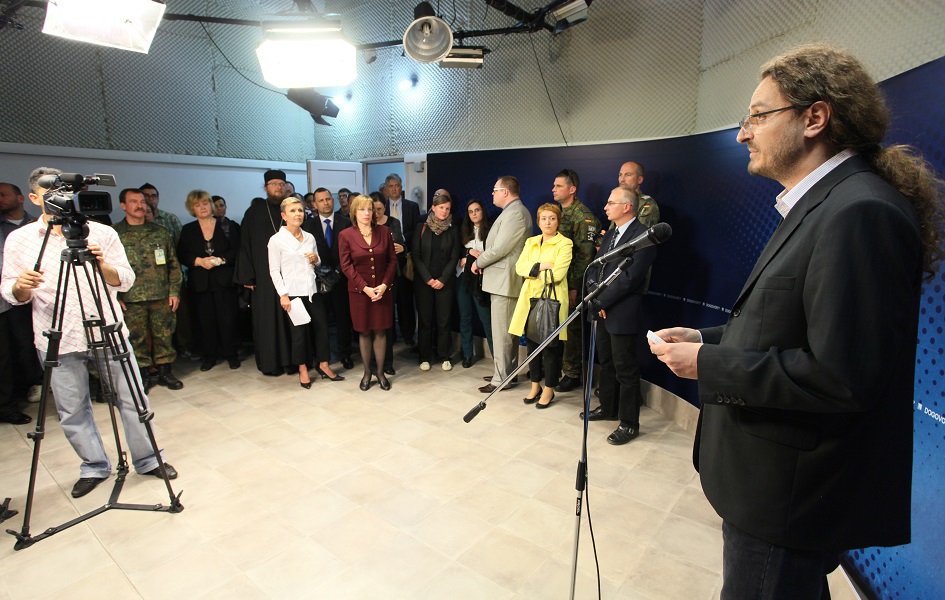
Isak Vorgučić’s long game of sustaining independent Serbian media in Kosovo*
In Gračanica, just outside Pristina, Isak Vorgučić runs a small craft brewery with his wife. It is physical work, measured, procedural, precise, and in many ways the opposite of newsroom life. Yet the logic is the same. Process matters. Steps cannot be skipped. If something is rushed, it won't be right.
For more than twenty-five years, Isak has applied that logic to journalism as the founder and editor of Radio KIM, the most established independent Serbian-language media outlet in Kosovo south of the Ibar River. Founded in December 2000, Radio KIM emerged from a specific post-war necessity: to provide reliable, locally grounded information about Kosovo to a Serbian audience that was almost entirely dependent on Belgrade-based media.
“At the end of the 1990s, there was a complete lack of information,” Isak says. “What was coming from Belgrade was ideological, emotional, and very often inaccurate.”
By the time Radio KIM went on air, the Milošević regime had already fallen, and Isak assumed their window of relevance might have closed. “We thought our work would no longer be necessary,” he recalls. “But unfortunately, even twenty-six years later, we are still fighting the same battle.”
That battle, as he defines it, is not political alignment but informational integrity. “Our mission has stayed the same,” he says. “To resist disinformation and to provide verified, factual information about Kosovo, not only for the Serbian community here, but for anyone who wants to understand what is really happening.”
An editorial approach focused on credibility
Radio KIM’s editorial approach is deliberately conservative in method. “It was never important for us to be first,” Isak says. “What mattered was that the information was checked, preferably from multiple sources.”
In a media environment shaped by speed, social media amplification, and competition for attention, this choice comes with clear disadvantages. Faster outlets attract more clicks, and sensational framing travels further. But Isak insists that credibility is cumulative, not immediate.
“We always tried to avoid unnecessary panic,” he explains. “Even when news has a negative context, the question is what is behind it, what the real consequences are, and whether there is a solution. Journalism should not make life harder for people than it already is.”
This approach has shaped Radio KIM’s audience. While its primary target is Kosovo’s Serbian community, the outlet is also followed closely by international actors and by Kosovo Albanians who want insight into how Serbian communities understand political and social developments outside nationalist framing.
Operating in Kosovo requires navigating pressure from multiple directions. Serbian state-aligned media continue to influence public discourse through content shaped in Belgrade. At the same time, Kosovo’s political climate has become increasingly intolerant of minority voices.
“We are not favourites of either side,” Isak says. “We receive attacks from both sides, often for the same reporting. For me, that only confirms that we are on the right path.”
Challenging financial times
Unlike in Serbia, where state advertising and political financing dominate the media market, independent Serbian-language media in Kosovo survive largely through international donor support. This has preserved editorial independence, but at the cost of constant financial insecurity.
“Sustainability is always fragile,” Isak says. “Independent media here exist because donors believe independence still matters.”
That fragility has deepened in recent years. The withdrawal of US funding and the contraction of European programmes have placed many outlets in Kosovo at risk. For Radio KIM, the threat is concrete: broadcasting equipment installed more than two decades ago is nearing failure.
EED support has enabled Radio KIM to renew its infrastructure and continue operating at a time when technical collapse would have silenced one of the few remaining independent Serbian-language media voices in Kosovo.
“It’s about whether professionalism and independence still have space. Without this kind of support, independent journalism here cannot survive,” he says.
Minorities as targets
Isak's critique extends beyond media. He argues that the current government’s growing reliance on nationalist rhetoric is less a sign of strength than of exhaustion.
“Nationalism is often used to cover the inability to deliver,” he says – whether on economic development, corruption, or Kosovo’s increasingly fragile strategic positioning with international partners. As relations with both the EU and the US stagnate, political energy is redirected inward, toward symbolic conflicts and identity-based mobilisation.
In that context, minorities become convenient targets. Kosovo’s Serbian minority – now around five percent of the population – is not a constituency to engage with, but an obstacle to be managed. “A very small minority is treated as a major national problem,” he says. “Instead of asking what people need in order to live normally.”
For Isak, this dynamic mirrors broader global trends. “We see it everywhere,” he says. “When governments can’t provide economically or strategically, they retreat into nationalism. It’s happening far beyond Kosovo.”
He is wary of nationalist politics on both sides of the Kosovo-Serbia divide. “Nationalism does not improve the economy, it doesn’t fix healthcare, and it doesn’t stop people from leaving.”
Asked how this entrenched sense of “otherness” can be challenged, Isak rejects political shortcuts. Agreements alone are insufficient, he argues, and reconciliation cannot be outsourced to institutions. “Only personal change can break that cycle,” he says. “Someone has to be stronger and stop first.”
Asked who he considers a personal hero, Isak avoids naming individuals. “A hero today is anyone who manages to resist the general madness,” he says. “Someone who rejects hatred and violence, and who insists on seeing a human being first, before nationality, religion, or identity.”
That definition mirrors Radio KIM’s editorial ethos. The outlet refuses both clickbait and identity-based mobilisation.
“Our approach to journalism is still traditional,” Isak says. “Verification, context, responsibility. We follow social media and new platforms, but we don’t allow trends to pull us into misleading or tabloid journalism.”
After more than two decades, Radio KIM has survived not by being louder or faster, but by being more careful. Its endurance is not accidental, it is the result of editorial choices that put responsibility over alignment.
Like beer, Isak would argue, journalism cannot be rushed without losing its character. Trust, in both cases, is brewed slowly – or not at all.
* This designation is without prejudice to positions on status, and is in line with UNSC 1244 and the ICJ Opinion on the Kosovo Declaration of Independence.
This article reflects the views of the grantees featured and does not necessarily represent the official opinion of the EED.
This article includes an AI-generated audio version to offer readers an additional way to engage with the content. As the narration is produced using automated voice technology, occasional inaccuracies may occur.