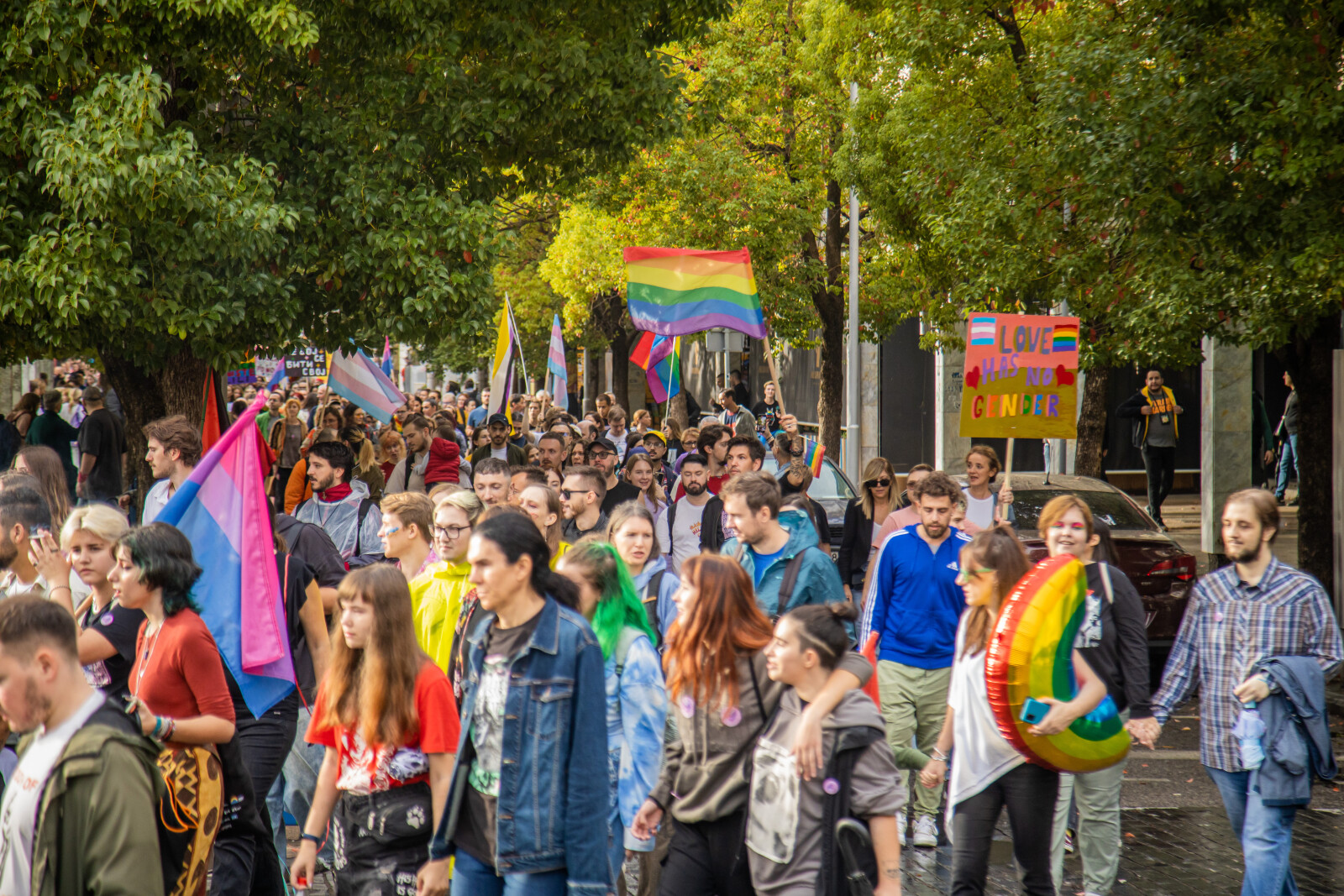
How Queer Montenegro is building its own community, one march at a time.
Staša Baštrica was sixteen years old when she stood outside a small building in Podgorica, convinced she was the only LGBTQI+ person in Montenegro.
"I thought I'd have to hide it all of my life," she recalls. In school, all her peers dated openly, but everything around her was heteronormative. The world seemed to have no place for her.
Inside that building, she discovered something different.
The drop-in centre run by a local NGO was small. Volunteers were settling in people and others were milling around. But they were doing important work that was about changing the system - it was, as Staša notes in her conversation with EED, "groundbreaking work".
"That's what inspired me. I didn't want to hide any part of myself just because society told me I had to."
Today, Staša is the Executive Director of Queer Montenegro, one of the best known LGBTQI+ rights organisations in the Western Balkans. At 32 years old, she has been a queer rights activist for almost half of her life.
Here and Queer
Her first Podgorica Pride took place in 2013 was nothing like the Pride events that followed. "There were two cordons of police around us," Staša recalls. "Hooligans were rioting. It was crazy. They had to drive us to a safe spot, far from where we were marching.” Staša spoke publicly for the first time at the press conference before the march.
More than a decade later, the streets of Podgorica tell a very different story. Pride still draws a visible police presence, but the riots are gone. Shops stay open and residents have learned to expect the closed streets and the marching.
That shift was the product of years of painstaking work: visibility, advocacy, legal pressure, and the simple stubborn act of being visible.
Funding and queer culture
When funding to LGBTQI+ organisations was cut last year, the effects were swift. "We didn't know if we were going to make it as an organisation," she says, admitting that they had to let staff go, were unable to guarantee salaries and had to put plans on hold. EED stepped in with core support, covering their basic operations: people, office, equipment, services.
"Core support is what civil society organisations need," she says. "It pushes you from survival mode, so that instead of focusing on how to pay salaries, you can focus on working for the community."
With that stability, Queer Montenegro was able to hire a Community Officer focused on building a community of LGBTQI+ people across Montenegro.
This new Community Officer also brought a vision of what queer culture in Montenegro could look like. She explains that historically, queer culture has been fragmented and largely invisible in public life, shaped by a lack of safe spaces, limited representation in media and arts, and the absence of openly sustained LGBTQI+ cultural institutions.
Montenegro has never had a visible drag scene, but last year Queer Montenegro helped spark its emergence, introducing drag as a form of storytelling, resistance, and visibility within a wider queer cultural expression.
But for Staša, queer culture is not limited to drag. It also includes everyday practices of visibility and belonging: community gatherings, queer film and art, shared language, activism rooted in lived experience, and spaces where LGBTQI+ people can safely express identity beyond dominant norms
"If our culture is invisible," Staša asks, "then who are we? What are we representing?"
Support Without Borders
Today Montenegro has one of the higher LGBTQI+ legal rankings in the Western Balkans region, and this is a reputation that travels.
A significant number of LGBTQI+ people from Russia, Turkey, Belarus, and Azerbaijan have arrived in Montenegro seeking safety. Some came believing they had found a haven, although Staša admits it's more complicated than that.
"Our system is not equipped to work with LGBTQI people," she says. "If you add that a person is an immigrant or asylum seeker… you can imagine."
Queer Montenegro now runs a dedicated programme to support LGBTQI migrants and asylum seekers: with peer support, legal and social counseling options available. Since its launch, more than twenty people have received direct support.
"We want them to know they’re not alone.”
The Law That Has Not Come
For all the progress, one gap remains conspicuous. The Law on Self-Determination, which would allow legal recognition of gender identity based on self-determination, has not been adopted.
Montenegro's government is pressing toward EU membership by 2028. Closing Chapter 23 of the accession process depends, in part, on this law.
"This is the right moment for this law to be adopted," Staša says. "I don't expect it to be adopted after we access the EU. The political will won't be there then."
She is clear-eyed about the limits of what the EU can offer and about what European accession pressure makes possible. The law on same-sex partnership was adopted in 2020, in part because of EU pressure. She firmly believes that the next step is possible too, if organisations like hers keep pushing.
The Long Road Ahead
Burnout is a word that comes up often in Staša's conversation. "Rest is part of resistance," she says. "It's something we don't take for granted."
She relates that the Queer Montenegro team don't work weekends. When funds allow, they go on retreats. As director, she tries to ensure her team has space to breathe, because she knows what happens when they don't.
She's equally frank about the weight of expectation that falls on organisations like hers. Governments adopt strategies on gender equality and publish plans, but as she puts it: "The majority of measures are accomplished by civil society organisations. The system relies on us."
"We are there to provide infrastructure, to provide support,” she says. "But change comes from the broader movement. From the people."
But she believes people are slowly changing. "That's where it begins," she says.
This article reflects the views of the grantees featured and does not necessarily represent the official opinion of EED.
This article includes an AI-generated audio version to offer readers an additional way to engage with the content. As the narration is produced using automated voice technology, occasional inaccuracies may occur.