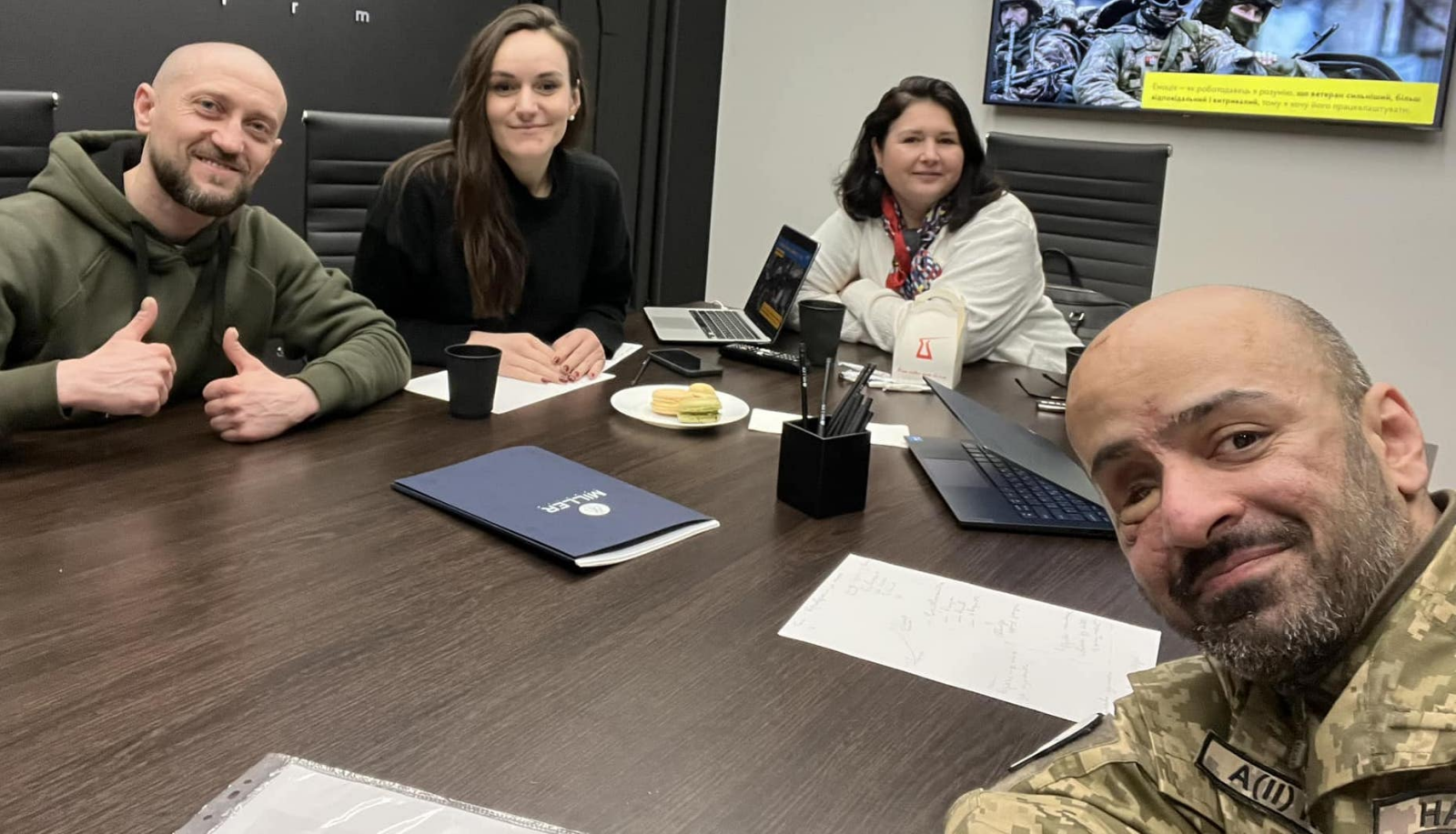
Liubov Halan is ensuring Ukraine’s veterans can reclaim their rights and place in society. And reshaping how the state serves those who served it.
When Masi Nayyem lost an eye while serving in the Ukrainian Armed Forces in 2022, he came home to a different kind of battle. The war had left him permanently changed, and so had the system he encountered upon returning. As he navigated the maze of medical bureaucracy and veterans’ services, he saw first-hand how even the most determined soldiers could be defeated by paperwork, policy gaps, and indifference.
A lawyer before the war, Masi recognised what few others could see so clearly: the problem wasn’t a lack of laws, it was a lack of connection between those laws and the lives they were meant to serve.
That insight became the foundation of Pryncyp, meaning Principle in Ukrainian, a civic initiative he co-founded with Liubov Halan, a human rights advocate with a sharp mind for systems and a deep sense of moral urgency.
“We’re expecting 1.5 million veterans by the end of the war,” Liubov says. “Together with their families, that’s nearly three million people. A country cannot afford to fail them.”
Turning complexity into clarity
Pryncyp’s first creation was deceptively simple: a rights navigator, a digital self-help tool that guides veterans through the dense architecture of Ukraine’s legal and social support systems. But behind that simplicity lies a profound shift — an attempt to make the state legible to its citizens.
“The navigator uses plain language to explain what the law says, what actually happens in practice, and what steps people can take if their rights are denied,” Liubov explains. For a wounded soldier or a mother caring for her son, that clarity can mean the difference between helplessness and agency.
The tool also educates. Civil servants, social workers, and medical professionals use it to understand their roles in a system that too often obscures responsibility. And it exposes another truth: while most veterans are men, it is usually their mothers and wives who take on the invisible labour of paperwork, care, and advocacy. “The navigator makes things easier for them too,” says Liubov.
From one story to a system
What began as a modest initiative by a handful of volunteers has grown into a fifteen-member organisation running six interconnected projects on veterans’ rights, advocacy, and policy reform. With early support from the European Endowment for Democracy, Pryncyp evolved from a small legal effort into a movement shaping how Ukraine understands reintegration and responsibility.
“We started by focusing on veterans with disabilities,” Liubov recalls. “Now, we follow the entire journey, from the moment someone is drafted to when they return as veterans seeking support. We’re mapping the system as a whole to understand where it breaks, and how to fix it.”
This systems-level thinking defines Pryncyp’s approach. Working with more than ten partner organisations, Liubov and her team coordinate advocacy efforts, analyse legislation, and push for institutional reform. “Only a united civil society can truly advocate for veterans,” she says. “We coordinate, we study, we propose — and we make sure those in power listen.”
Their work exposes a familiar paradox of post-Soviet governance: laws that exist in theory, but not in practice. “Even if the law says veterans can access free prosthetics or rehabilitation,” Liubov notes, “the infrastructure and funding often don’t exist. Our role is to reveal these gaps and show how to close them.”
Back to work
Employment is Pryncyp’s newest frontier. For many veterans, particularly those with disabilities, the struggle for dignity continues in the job market. Pryncyp partners with companies to promote inclusive hiring and workplace accessibility — not as an act of charity, but as part of Ukraine’s reconstruction logic.
“We highlight positive examples of employers hiring veterans and show others that it works,” says Liubov. “Given how many people will return from the front, we need structural solutions that make reintegration possible.”
There is now, she adds, “a genuine political will” to address veterans’ issues. The challenge is turning that will into policy. And policy into institutions that endure. “Our advocacy will be decisive in shaping veterans’ policy in the years to come.”
What began with the loss of sight has grown into a vision — one that sees veterans not as the state’s responsibility to manage, but as citizens whose rights complete the idea of democracy itself. Pryncyp’s mission, Liubov says, is “to make sure that every veteran, no matter where they live or what they’ve lost, can find their way back into society, with their rights intact.”
This article reflects the views of the grantees featured and does not necessarily represent the official opinion of the EED.
This initiative was supported thanks to the contribution of the European Union to EED.