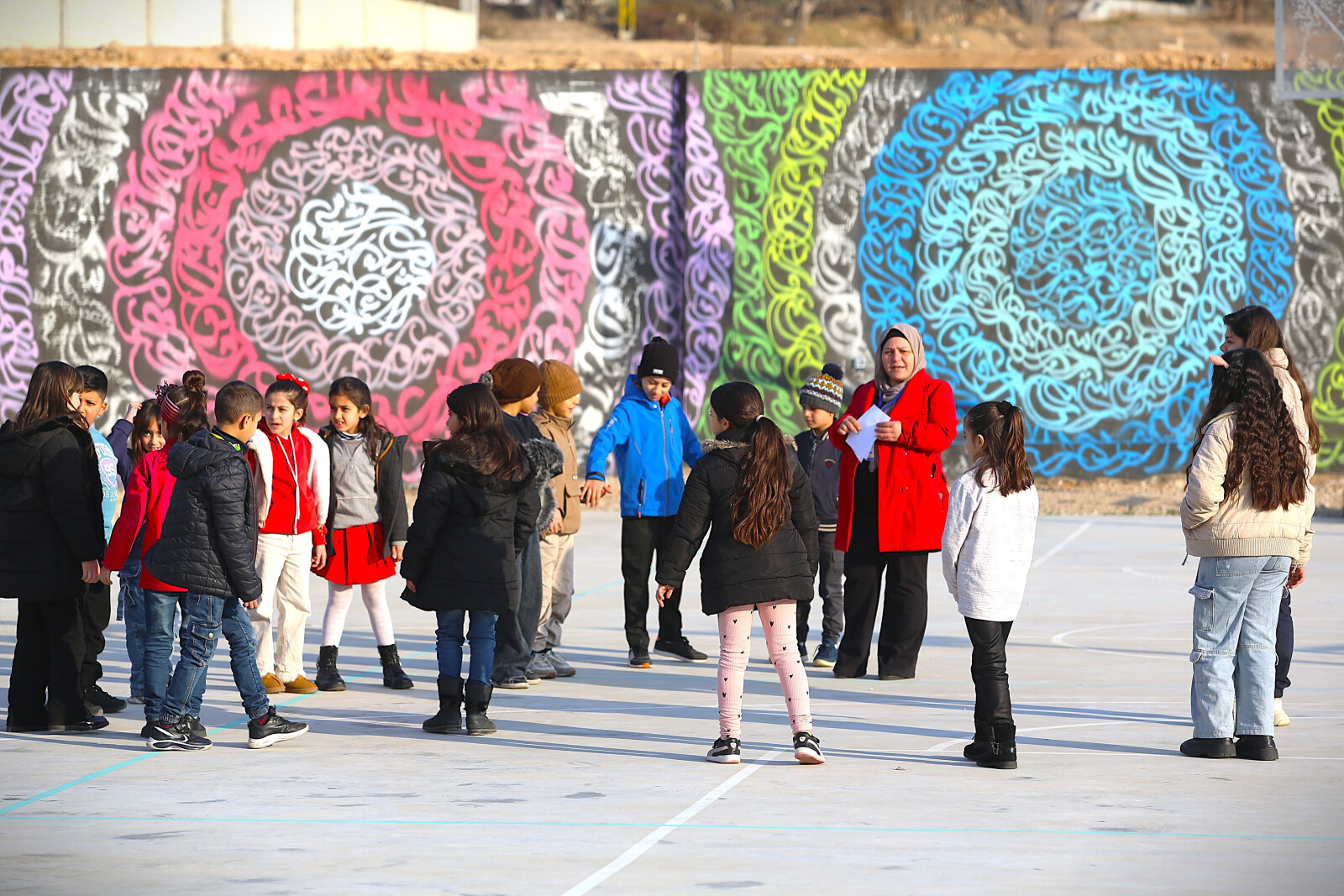
Creating a rare space in Lebanon’s Bekaa Valley where young people from diverse communities can meet, talk, and create and dream together.
The room is quiet at first. Teenagers from three neighbouring towns in Lebanon, places divided by sect and politics, sit in a circle, nervously avoiding eye contact.
On the table between them rest a few musical instruments, a guitar, a tambourine, and a small keyboard. For a while, no one moves. Then, a young girl reaches out and strums a single note on the guitar. Heads lift. Someone taps the tambourine. Another joins with a rhythm on the table. Within an hour, laughter replaces silence, and melodies fill the room. Strangers begin to sound less like strangers. By the end of the day, they’ve formed a band, their differences fading into harmony.
Peace of Art began in 2016 as a humanitarian group and artistic academy, giving Lebanese youth the chance to develop their creative skills. Its founder, Mahdi Yahya, a teacher and activist from North Bekaa, quickly realised the real challenge wasn’t just cultural, but political. It was about giving youth the power to express their desire for a better future, and instilling hope.
“Providing them the space to gather together, without necessarily identifying each other as belonging to either this or that background” he says. “Showing our similarities, not just focusing on our differences.”
The path, Mahdi believed, was art. Art as a method of connection, expression, a way to heal, connect, to create a new kind of future together.
Pathways to Peace
Teenagers in the Bekaa region are amongst the most vulnerable to sectarian rhetoric. With over 18 different religious groups in Lebanon, many rarely meet peers from another background. Extremist groups often exploit this vacuum, offering alternative ways of belonging and identity, especially for disillusioned youth.
Economic instability, high levels of youth unemployment, and the constant threat of further escalation creates a fragile environment. Peace of Art seeks to change that.
It may sound simple, but it is radical. The answer lies in the ability to bring people together. A blend of civic education workshops and training in leadership, conflict resolution, and communication provides the foundation.
Then comes the art: photography, music, acting, drawing, and film, all culminating in a final showcase exhibition. The goal is to transform individual experiences into collective works of art, into shared projects of hope for a better future.
Peace of Art has grown from a small community initiative of nine years ago into a movement reaching multiple towns and programmes, touching the lives of thousands of young people across Lebanon’s marginalised areas every year.
Over time, its work has expanded beyond art to include humanitarian relief, education, environmental initiatives, and interreligious dialogue. Mahdi notes that these are all rooted in the same belief that creativity and compassion can bridge divides
Through music, painting, and even Lebanon’s historically significant practice of weaving, Peace of Art offers a pathway to a different kind of world, a peaceful one. It’s what keeps Mahdi and his team of volunteers moving forward.
Creative Connection
Peace of Art faces many challenges, in a region full of instability. Whilst navigating Lebanon’s rich social fabric, the organisation also deals with some pushback from conservative groups and political factions, increasingly hostile to the NGO sector. But Mahdi has a solution: greater cooperation amongst civil society.
Working together with other NGOs active in the region, Peace of Art has begun to connect with organisations to form what they call the Working Assembly of Rights & Dialogue. As an assembly of NGOS, all working in Lebanon, this alliance allows connection and cooperation across organisations to gather in the pursuit of stronger – better – and more peaceful communities. It enables them to confront their challenges together, whilst maintaining their independence.
That independence has earned Peace of Art credibility, but also risk, as some local political and religious actors see any message of tolerance as a threat. To navigate this, Peace of Art frames its work in cultural terms - art exhibitions, performances, workshops, while embedding the values of citizenship, rights, and freedom within them.
This approach also makes the work accessible. Artistic expression requires no political jargon. It gives teenagers a chance to process trauma and imagine new futures in a way that textbooks cannot. “It gives them an outlet,” Yahya says, “A place of safety and exploration.”
Weaving the Social Fabric
Resources are always tight, and risks are around every corner. The organisation has had to weather obstacles from every corner. Support from EED at the outset of the project in 2017 was game-changing.
“The support enabled us to go further, and survive,” he says. “To learn and grow as an organisation.” These skills are crucial to keep Peace of Art going, and help them plan for a future, even in the most volatile of times.
A Kaleidoscope of Community
In a region where few alternatives exist, Peace of Art changes the lives of Lebanon’s youth. Each participant represents a shift away from sectarian narratives, towards cooperation and new forms of democratic citizenship.
The outcomes are clear: young people working together across divides, new leading voices emerging, and, perhaps most importantly, the beginnings of trust in a place where division has long been the norm.
“I don’t know what the future holds,” Mahdi muses. “All I know is that I’m thankful I have given a space to change our society for the better.”
This article reflects the views of the grantees featured and does not necessarily represent the official opinion of EED.