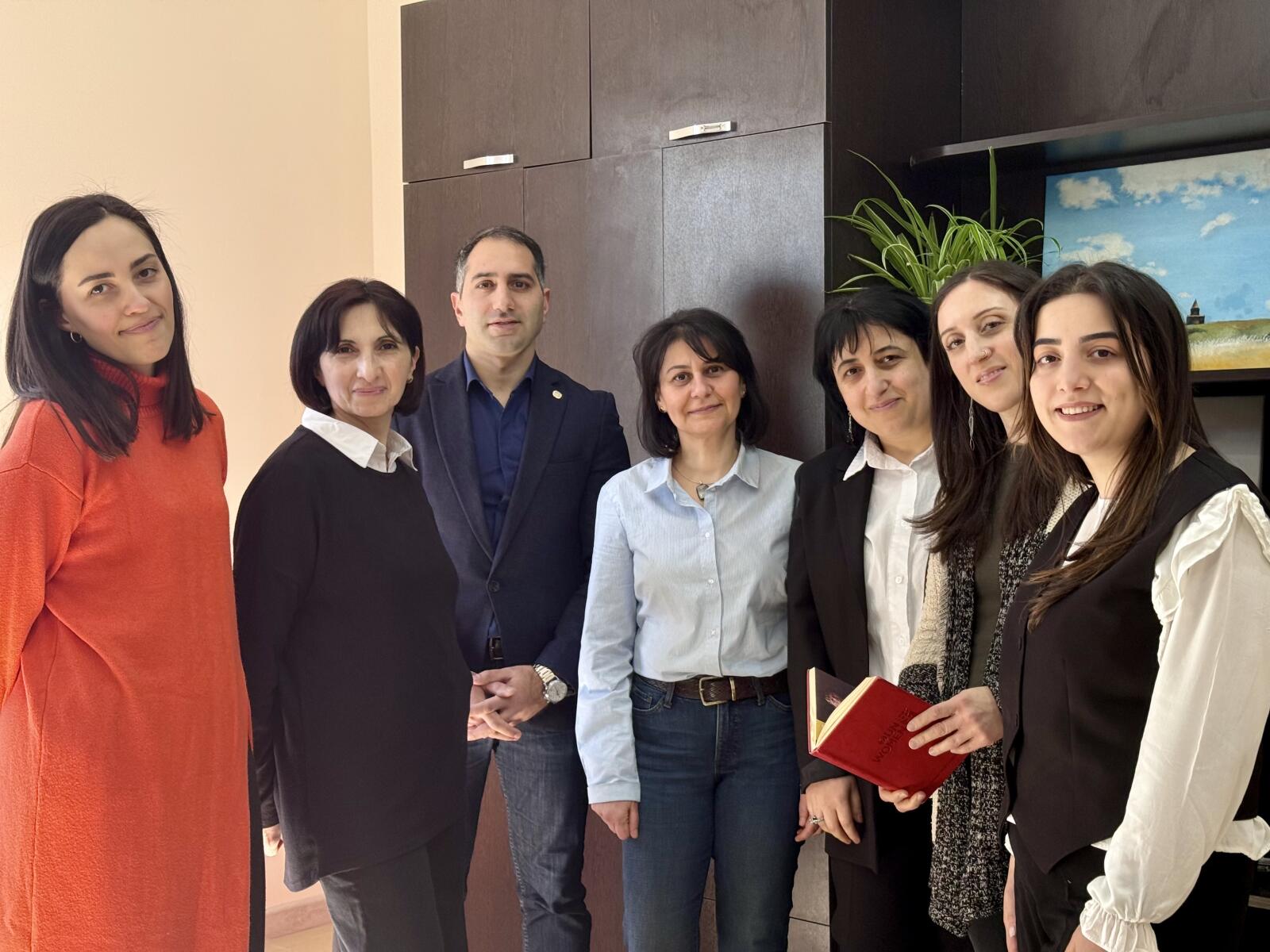
Ani Jilozian, Zara Hovhannisyan and Hasmik Gevorgyan have collaborated for more than 15 years. When they all left their previous organisation, they realised that between them they covered human rights, law, journalism, creative arts and public health. They wanted to build something together.
“It would have been a waste to go our separate ways,” says Ani, one of the three co-founders of New Justice Culture.
Founded just over a year ago, New Justice Culture is contributing to what Ani calls “a new culture of justice”, re-examining what human rights and justice mean in Armenia and enabling people to live dignified lives.
The three women began the process of founding the new organisation by listening, meeting with former partners, institutions and the Police to map where the real gaps were. This process helped shape their three-year plan and led them to do work they would not initially have envisaged.
They explain that domestic violence remains a huge problem in Armenia despite improvements in recent years.
Reporting of domestic violence incidents has increased as women have become more aware of their rights. The 2017 Law on Domestic Violence has meant that the Police response has improved dramatically, and they are now more educated about domestic violence issues. Today, Police routinely issue emergency barring and protection orders.
However, there are still significant gaps. Ratification of the Istanbul Convention remains stalled, meaning there is insufficient legal protection for women and domestic violence survivors. While there are services across the country, institutions remain weak and there are not enough skilled practitioners.
There are particular challenges amongst refugees from Nagorno Karabakh, as many displaced women have large families, and face financial hardship and trauma that make leaving a violent home very difficult. Legislation standards in the enclave were always lower when it came to domestic violence, and as Ani relates, “Often the women don’t understand that they are victims.”
There were also no programmes in place for perpetrators of domestic violence in Armenia. So when the state launched the first national pilot programme, the team saw it as a good fit.
“The perpetrator work is a logical continuation of the work we've been involved in for many years,” says Ani. “Having been in the domestic violence field for so long, focused on victim safety, we felt it was a great opportunity to help build the framework for this very important national programme, which really requires a feminist lens, grounded in human rights, and experience working with domestic violence survivors.”
Perpetrators participate in the programme on a voluntary basis. Some find the centre through the police, state agencies, NGOs and schools, and others self-refer. Each individual goes through an intake assessment and individual sessions with specialist staff. Group work is envisaged for the next stage. Over the past ten months, the centre has worked with 41 clients.
The team draws on international training modules they adapt and international networks. “Men in Armenia face different issues,” Ani says. “We have a standard methodology we can use, but it doesn’t always fit our context.”
EED was the centre’s first funder after its establishment. “EED is one of the very few donors that offers institutional support, especially to newly established organisations,” Ani says.
This funding enabled them to secure an office, which was vital for their perpetrator work as they needed to have a space to meet clients. They believe this was vital in securing the ministry contract for this work.
Over the past year, the centre has developed into an eight-person team and has launched several projects.
It is rewriting the community police’s school modules on issues such as online safety and drugs into interactive, child-friendly lessons that they deliver to high school students. The next phase of this project is training of Police officers. They hope to pair their psychologists with community police officers in the classroom.
It is carrying out research and policy work on gender-based violence, as well as prison monitoring work.
It also has launched media initiatives, including new podcasts. “One podcast is outward facing, in English, covering research, policy and issues related to human rights and justice,” says Ani. “The other is in Armenian. We want to reframe human rights and justice and the societal issues by asking questions that haven’t been asked before and talking about topics that may be a bit taboo or different.”
Zara is also a columnist, where she writes on human rights in editions such as Medialab and Civilnet, both EED partners.
Another creative project with the Museum of Literature and Arts is reviving the legacy of Shushanik Kurghinian, a female poet and writer from the turn of the 20th century, through archival research and digitisation, an exhibition, a short documentary and the development of school materials.
The team has also been vocal about the framing of “domestic and household violence” introduced through 2024 amendments to the domestic violence law. They argue that this framing obscures the gendered nature of domestic violence and risks conflating patterns of abuse and coercive control with other household conflicts, with consequences for how cases are identified and addressed.
The three founders see their work as essential to a wider healthy society, and they emphasise that it is couched in the grassroots spirit of their years of experience. They have adopted a non-hierarchical structure to manage the new organisation. “If you want to advocate for a more just society, change needs to start with yourself,” says Ani.
“For a society to flourish, we need to address the root causes of violence, so that women and other vulnerable groups can achieve things in other social realms,” she continues. “Violence and discrimination cut the roots of the tree and don't allow a society to flourish.”
Asked why they do are determined to continue with this work, Ani answers with a question: “What else would we do?” For Zara, “It’s not work, it’s a lifestyle”.
This article reflects the views of the grantees featured and does not necessarily represent the official opinion of EED.
This article includes an AI-generated audio version to offer readers an additional way to engage with the content. As the narration is produced using automated voice technology, occasional inaccuracies may occur.