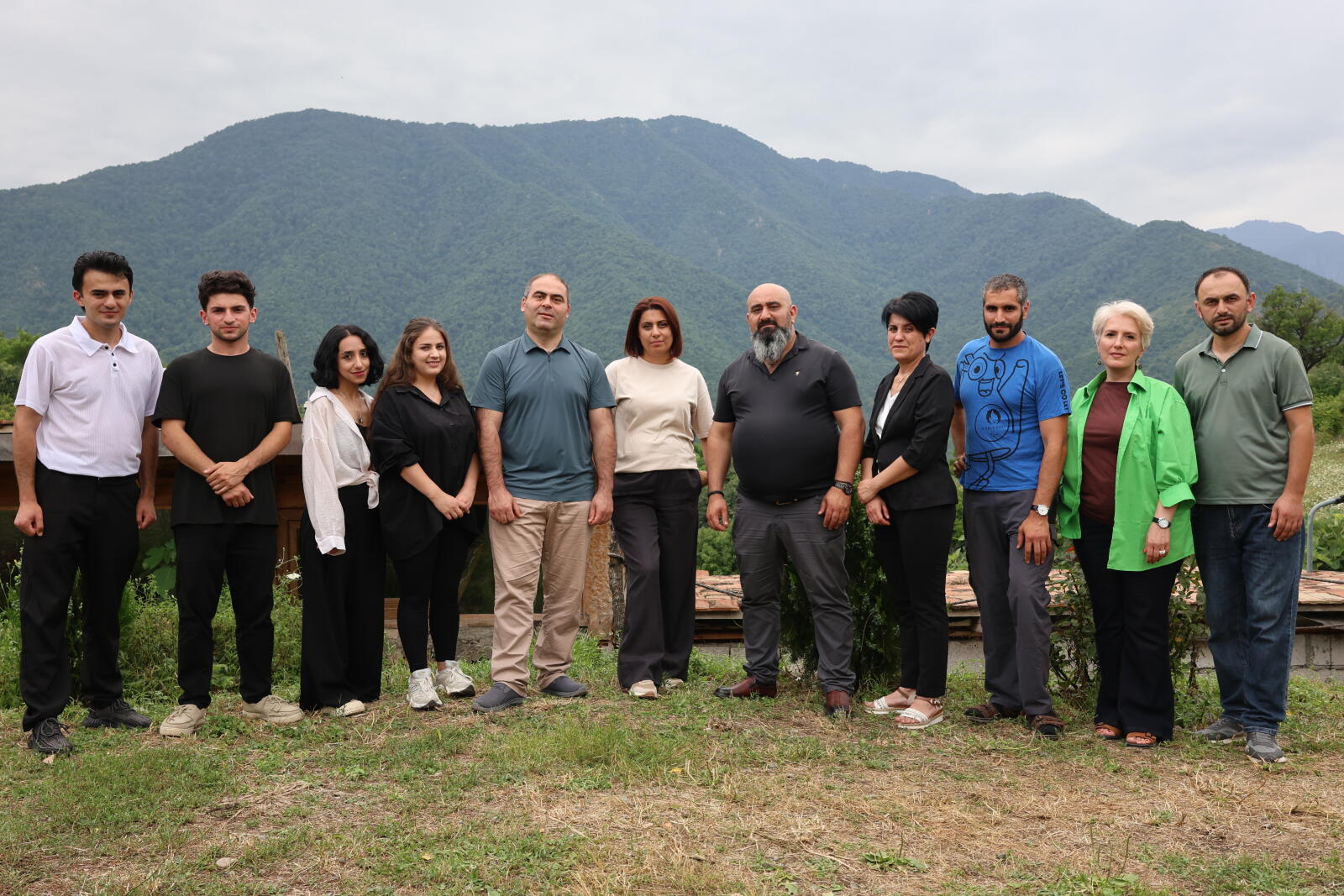
“Our mission isn’t just ecological,” says Oleg Dulgaruyan, who heads the Centre for Community Mobilisation and Support (CCMS) in Alaverdi in the Lori region of Armenia. “Our mission is democracy: developing active citizens.”
Founded in 2009 by 25 people from ten different communities, CCMS is a grassroots civic organisation that grew out of local struggles against mining. Today, it works from the north to the most southern tip of Armenia. It works to empower citizens to influence decision-making through dialogue and advocacy, ensures media outreach, contributes to institutional responsiveness, and assists in progressing environmental legislation.
As far as Oleg is concerned, there are two big problems in Armenia’s regions. The first is the pollution risks and impacts associated with mining activities; and the second is that new mines are being opened in nearly a quarter of villages in some regions, such as the Lori Province.
These concerns took on added significance in October 2026, when Armenia hosted COP17, the UN Biodiversity Conference, in Yerevan. While the government presented itself on the world stage as a champion of nature, activists like Oleg pointed to the gap between those commitments and the expansion of mining in the country’s regions.
“Part of our work is following up on what has already happened, and the other part is trying to make sure it doesn’t happen,” he says. “We advocate for people’s right to live in a healthy environment, and we monitor the impact of pollution on the environment and on public health.”
The only activism that works in the regions
Oleg believes that ecology is the one subject around which citizens can still organise in Armenia’s regions. “It’s the only instrument of local democracy,” he says.
He relates that ten years ago, environmental activism was concentrated in Yerevan, whereas today, environmental activism is more decentralised, with active movements emerging directly from the regions and collaborating countrywide.
Thanks to CCMS’s community mobilisation, its efforts to raise public awareness and its collaboration with local residents, it has succeeded in halting several harmful investments and in preventing private companies from opening mining sites with potentially serious human rights impacts.
A Green Academy for activists
In 2024, CCMS set up the Eco-activism Academy, Armenia’s first programme in ecological activism, open to people of all ages.
It has already run six programmes, each lasting three to four months and combining online learning with three residential sessions. Oleg explains that participants apply with a local environmental problem they have already researched. During the programme, they learn how to research, mobilise, organise and carry out public advocacy campaigns that are in the public interest. The learn how to manage a civil society organisation, and they are paired with mentors. Around 20 to 25 people start each course, and half that number complete it.
The results often outlast the course. In August 2026, following sustained community mobilisation and advocacy by Academy graduates and local activists, the Tsaghkadzor Community Council formally adopted a policy document on the protection of the Marmarik river in the Kotayk province.
“This is more than an agreement by local authorities to protect a river,” says Oleg. “It is an important step towards institutionalising environmental protection at a local level. It shows how grassroots activism can translate into concrete policy outcomes and strengthen local democracy in practice.”
A network that shows up
In 2025, community eco-activists from across Armenia created the Federation of Green Councils, a new eco-activist movement of around 100 activists, including young people, women, farmers, green businesses and eco-tourism operators. Its goals are to protect the environment, strengthen local democracy, promote social justice and support green, sustainable development.
Prior to the 2026 elections, the group came together to fight hybrid attacks and Foreign Information Manipulation and Interference (FIMI) in their regions.
Recently, activists and the local community worked closely together when it emerged that the local council in Stepanavan had given permission for a geological survey on mining to be carried out, without any transparency or meaningful public participation. Federation members travelled from across Armenia to support the community during public hearings, gathering over 1,000 signatures and organising a media campaign. This sustained civic pressure led Armenia’s Ministry of Environment to issue a negative opinion on the project.
Giving the regions a voice
CCMS also runs Citizen’s Voice, edited by Oleg’s colleague Natalia Osyan, an eco-activism media platform focused on citizen journalism, public interest reporting and amplifying voices from local communities across Armenia. Its mission is to bring regional and public interest issues to the national conversation. It has around 4 million views a month across all its platforms. EED support enabled Citizen’s Voice to expand its work.
Oleg explains that Citizen’s Voice fills an important gap, as most media are based in Yerevan, and regional stories rarely reach a national audience and environmental issues are not covered. For instance, it was the only outlet to write about the Marmarik river victory.
The team is now training regional journalists and building an informal network.
Working under pressure
CCMS’s work protecting the socio-ecological rights of communities in Armenia and carrying out research on environmental issues can mean that it also comes under attack. Both CCMS and its network of activists have frequently been the subject of defamation campaigns in the media and Strategic lawsuits against public participation (SLAPPS) from mining companies.
Oleg tries to combat this pressure by combining grassroots work with high level positions in public consultative bodies. He recently convened a meeting with the Minister of Justice where it was agreed that Armenia needs anti-SLAPP legislation.
EED support has enabled CCMS to develop its network of partners. A current grant co-financing the purchase of a new premises, with CCMS covering the majority of the costs from its own income and covering renovation costs.
Oleg notes that a key area of interest for CCMS today is the protection of rural life. It is now engaged in a project to prepare draft legislation on this issue, working in collaboration with farmers. “When a farmer loses his farm due to mining he gets no compensation,” says Oleg. “There is no mechanism to protect him or any support, not even for health issues.”
Democracy from bottom-up
The environment has long been an issue of importance in this country, and Oleg recalls that the movement for independence from the Soviet Union began with environmental protests. He also believes that democracy needs to be strengthened from the bottom. “If you have democracy at the top and not at the bottom, it will simply collapse,” he says.
Looking back at the work of CCMS over the past seventeen years, he is most proud of the network they have created. “If there is a problem 300 kilometres away,” he says, “people will go that very day to support the local community.”
This article reflects the views of the grantees featured and does not necessarily represent the official opinion of EED.