Fady Asleh is writting Palestine’s counter-history, one family story at a time.
In a small village in the Galilee, a boy grew up hearing stories that didn’t exist in books. His grandparents would talk about olive groves, schoolteachers, poetry, prison, exile—narratives that shaped lives but remained undocumented, absent from official records. Years later, that boy, now a trained historian and archivist, would return to those voices with a mission: to make them part of history.
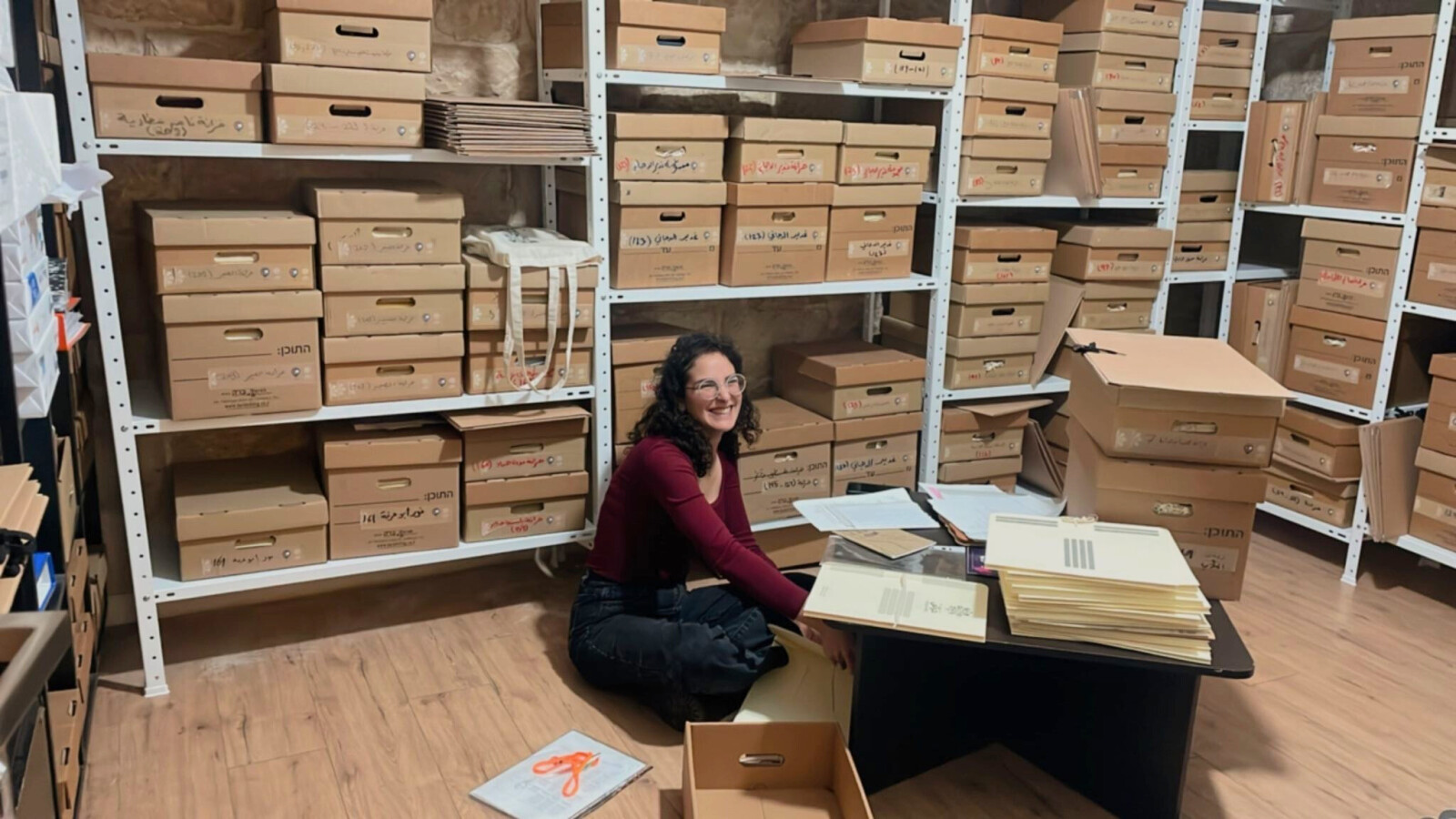
Fady Asleh is the founder of Khazaaen, a Palestinian digital community archive. But calling it an “archive” misses the point. Khazaaen—which means cabinets in Arabic—is a living, breathing network of memory. It collects, digitises, and shares fragments of Palestinian life: photographs, love letters, diplomas, protest leaflets, family stories, even poetry smuggled out of British prisons. It is, in his words, “the memory of the future.”
What makes Khazaaen radical is not only what it archives, but how it does it. “This is not my project,” Fady says. “It’s the community’s.”
With support from the European Endowment for Democracy (EED), Khazaaen has expanded its reach and deepened its impact. The funding has enabled a growing cohort of young volunteers to receive intensive training in documentation methods—digitisation, oral history, metadata tagging, storytelling. The young people have worked to document the decades-long dedication and struggle of the human rights movement in Palestine, archiving the work of Palestinian human rights organisations and ensuring that this valuable information is accessible to the broader public and interested stakeholders. EED’s support has also allowed Khazaaen to invest in technical infrastructure, hold public workshops, and collaborate with organisations across regions and generations. What emerges isn’t just a data set—it’s a deeply participatory model of memory-making.
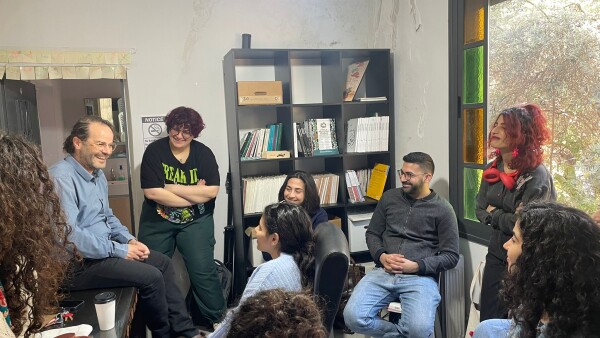
Then, if a family is willing to share its private collection, it is this new generation that does the work: scanning, writing, uploading, curating. The family remains involved at every step.
“We are not just collecting papers,” Asleh explains. “We are building connections—emotional, intergenerational, political.” He recalls one case where two long-time volunteers realised—through overlapping family documents—that their grandparents had come from the same village. That’s what archives do—they reconnect people.
At its heart, Khazaaen is a quiet act of resistance. Palestinian history, like Palestinian land, is under occupation. Asleh studied in Berlin, Jerusalem and Birzeit, and learned early on that most Palestinian documents are locked away in Israeli state archives—if not destroyed. “History has always been written by the victors,” he says. “And by elites. But the people in the street—they carry the consequences. They deserve to be heard.”
Khazaaen’s mission is to shift that authorship. “Ordinary people should write their history,” Asleh says. “They should decide what gets remembered—not wait for a historian to choose.”
One of the earliest archives Asleh collected came from a Palestinian family originally from Jaffa. The documents traced their forced migration: Jaffa to Lebanon, to Libya, to Canada and back again. It was a story not of geopolitics, but of school enrolments, rent receipts, bus tickets, birth certificates. As Asleh puts it, “You can see the refugee experience in the paperwork.”
One document—a handwritten poem—turned into a detective story. A family from the Galilee knew little about their grandfather, who had vanished in 1948. The poem, it turned out, was a revolutionary piece from the 1936 uprising. Cross-referencing colonial records and old newspapers, Asleh found a prison number, then an entry in the British police archive, and eventually tracked down an elderly man in Lebanon who remembered the missing grandfather’s story. “We brought them together digitally,” he says. “Across time.”
In today’s Palestine, documenting history is not only an academic pursuit. It’s a race against time. “In Gaza, homes are gone. Trees are gone. Streets are gone,” Fady says. “But if we have even a few images—of a tree, a street sign, a wedding photo—we can reconstruct memory. We can rebuild Gaza, if only digitally.”
But urgency doesn’t mean haste. Each cohort of Khazaaen volunteers spends three to four months learning the ethics and aesthetics of archiving. They read. They write. They digitise their own family materials. “It’s important that they understand the responsibility,” Asleh notes. This is not nostalgia. It’s evidence.
“I don’t believe in perfect objectivity,” he says. “But I believe in participation, care, and transparency. Those are our methods.”
Khazaaen, he believes, is also a form of psychological infrastructure. “Many people feel they are alone. But when someone wants to hear your story, to write about you—you feel that you are not invisible. You don’t disappear from history.”
His long-term dream? A college of archiving and the humanities—an institution that would merge preservation with pedagogy, training the next generation of memory-keepers. It’s a heroic effort, but Fady Asleh doesn’t like the word hero. “I like people,” he says. “The ones who face daily problems in silence. They’re the real ones.”
He speaks like someone who has spent his life listening—carefully, persistently—to what history tried to erase. “The Nakba tried to delete our existence. But we write. We archive. We stay.”
And for Asleh, that’s what makes this work matter.
“When your story is told,” he says, “you are born again. And again. And again.”
This article reflects the views of the grantees featured and does not necessarily represent the official opinion of the EED.