
An Arab-language online publishing platform born out of a desire to imagine another journalistic and cultural space in the Arabic-speaking world is using slow journalism to empower local voices to tell the stories of their everyday life.
“Our model is: look for yourself, find your own voice and your own question and talk about it,” says a member of the Khatt30 editorial team.
Founded in December 2022 by a group of experienced Arab journalists from six countries across the region, Khatt30 takes its name from the 30th parallel, the latitude line that cuts through most of the Arabic-speaking world. It was born during a period its founders describe as a hopeless time for the region, when there was no prospect of change in Syria, Egypt’s media space had narrowed dramatically, there was mass corruption in Iraq, and Lebanon was caught in the same cycle of violence. It seeks to speak from and to this region by recounting its events, stories, and everyday vernacular life through experiential and sensorial language.
“We wanted to imagine a different life,” they say. “Khatt30 was a space where we as an editorial team and authors could propose a different way of practising journalism.”
A new model of journalism
“We thought about how current journalism in the region is often built around competition for information, while most writing relies on traditional news formats,” they say. “We felt we were being pushed to write in an almost identical language and similar modes of expression. We thought about the imbalance in Arab journalism – we read many stories from countries like Lebanon for example, but hardly any from a large and complex country like Algeria.”
Their previous experience of working on a pan-Arab platform focused on North Africa also meant they had “learnt what we don’t want”. They wanted to come up with a new model for Arab journalism.
They asked themselves what happened to the soul of the Arab Spring, and they decided to focus on producing audiovisual pieces of slow journalism that examined in the overarching sociopolitical dynamics across the region, and how these translated into the people’s lived realities.
“We thought about the way life is full of many layers – economic, social, cultural – and how these layers are embedded in everyday existence,” they say. “We decided to choose simple worlds and work on them as journalistic topics – home, food, ageing, clothes, moving to the city.”
What sets their work apart is not only its depth, but its experimental nature and creative story telling that attempts to further engage with reality and to re-imagine it.
Some of their photography stories can take a year to produce. They publish audio documentaries and illustration journalism that are otherwise “completely missing in the Arab world”, and narrative long-reads in the reportage tradition, some as long as short books. All their production is copylefted, freely available for other media to use.
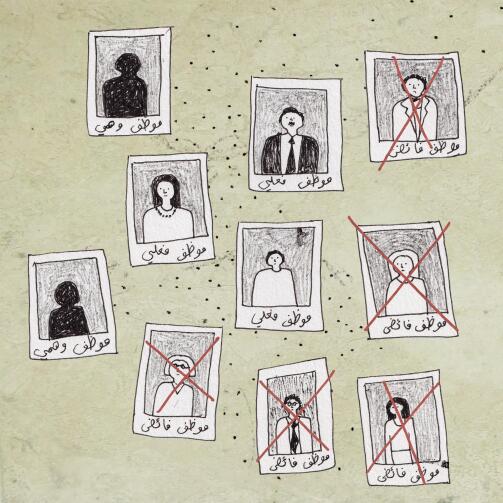
The team does not chase numbers either in terms of traffic or production, and they deliberately keep their production lean – five pieces per week, with the entire editorial team working on each story. “This was our recipe from the beginning,” they say.
They admit this is not always an easy process, and it has been a learning curve finding editors who understood their vision, but it is deliberate. “We invest in our fragility, not the solidity,” they say.
Finding and growing writers
The Khatt30 team reckon they have worked with up to 800 contributors so far, with none contributing more than three or four pieces each. Some journalists approach them directly and they actively seek out undiscovered talent.
“Sometimes we see a small post on Facebook, and there is a sense there is good writing,” they say. “Or our photo editor sees something on Instagram and says: ‘This person can make good photos, but they don’t know that yet’. We look for those people.”
The editorial team spans investigative, cultural, graphic and photographic journalism, as well as filming, and they accompany contributors at every stage of an intensive editorial process. Every two months, they also invite guest editors to join the team to work on projects, refreshing their editorial thinking.
“We ask them: why is this story important and then as editors and writers or photographers, we arrive at unexpected places,” they say. “Even when we write with established authors, we try to put them outside their safe zones, so they can surprise themselves.”
This approach extends to format. “We don’t have a fixed format for Khatt30,” they explain. “We search with every journalist for their own voice.”
Many contributors have gone on to win awards on work first published with Khatt30, making the platform a launchpad for new voices.
A space, not just a publication
The team's ambition extends beyond publishing. “We want Khatt30 to be a space for us as an editorial team and our authors to create a new ecosystem,” they say. “An Algerian author can work with a Somalian. Egyptians with Iraqis. The subjects we work on in our dossiers connect us. They are local questions, but they are also regional and sometimes international questions.”
Their target audience are the 20 to 35 age group, a digital native generation interested in cross-regional and international issues.
EED support is helping them achieve this ambition. EED supported the editorial team during a period of critical funding loss, enabling them to maintain their identity, continue running workshops to discover new talent, and to become a more stable and sustainable organisation.
Today their focus is on building closer relationships with their audience, who they see as a community. They are planning to launch a newsletter, and they are also thinking of ways to generate revenue for contributors.
Endless learning
The Khatt30 team are all busy people with day jobs in their own countries, but they are committed to developing Khatt30 as a space that can support the wider media sector. They dream of having a team like them in every country in the region and they already see the influence that Khatt30 is having on other media organisations.
On a day-to-day level, their motivation comes from how much they learn from this work and the joy it gives them.
“Every day I learn from authors, from every story,” one editor says. “And we shouldn’t ignore the fun. Working at Khatt30 is fun for everyone.”
This article reflects the views of the grantees featured and does not necessarily represent the official opinion of the EED.
This article includes an AI-generated audio version to offer readers an additional way to engage with the content. As the narration is produced using automated voice technology, occasional inaccuracies may occur.