A feminist media platform that is building a community of writers and readers across the Arab-language region
“Our contributors write content that is personal to them, so that others can feel they’re not alone,” say members of Jeem, an alternative feminist platform that seeks to challenge the under-representation of women and other excluded groups in the Arab speaking world.
Initially founded in 2018 as a project of the Goethe Institute, Jeem launched as an independent organisation registered in Berlin three years later. Its focus has always been on providing a voice for those usually silenced in the mainstream Arab-speaking media, including women and other minorities, migrant workers and refugees. This work is particularly important in the context of growing attacks from anti-rights movements in the region.
“People shouldn’t need to speak English or other languages to know more or to share their narratives, they say.
Jeem’s approach is as much focused on who produces its content and how it is produced, as what is published. Many of its analytical and personal texts that form the core of Jeem’s output are written by community members.
“This is a very important thing for us,” they say. “In Jeem, we don’t have outsiders writing about their communities.”
They commission pieces aligned with projects and thematic priorities, and they also receive pitches from writers. They work collaboratively with them, providing an editorial accompaniment process that they consider central to their identity.
“We work with writers until the work is complete, and we’re all satisfied with it,” they say. “Some of our contributors are young and are publishing for the first time with Jeem, and we grow with them. Others are established writers. We have a strong and trusted relationship with all of them.”
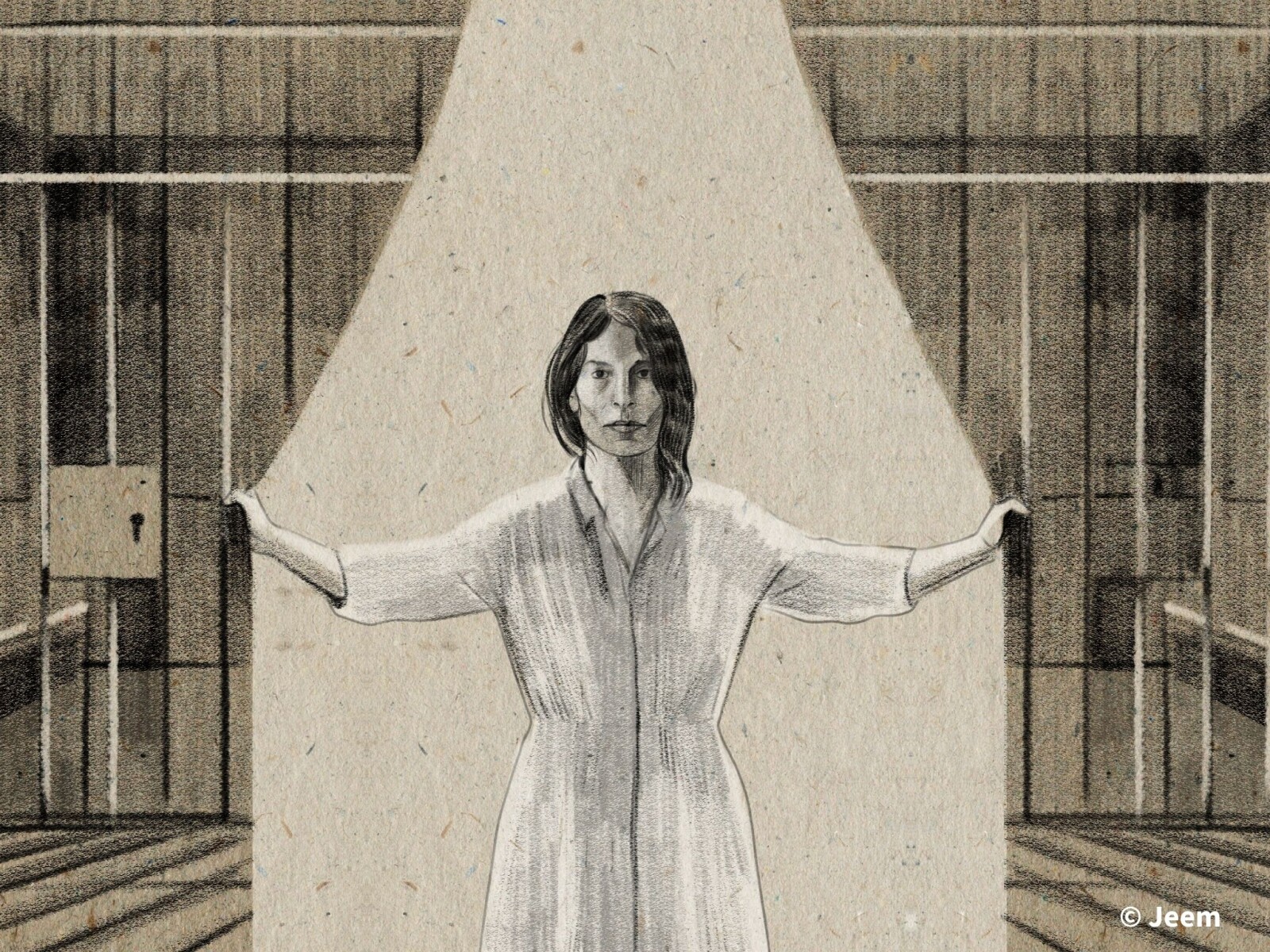
Last year, Jeem worked with 56 contributors, mostly from the Levant, Egypt, Tunisia and Sudan, with a handful of writers from Yemen, the Gulf region and Algeria. The content they produce is diverse: analytical articles, illustrations, comics, investigative pieces, podcasts, and online panel discussions for members, and they try to take a regional approach with all their work. They have tens of thousands of regular readers, and they are particularly proud of the striking visuals that accompany each piece that are produced by their in-house multimedia team.

© Jeem
Intersectional feminism in practice
Their editorial focus is rooted in intersectional feminism, with a particular commitment to displacement, conflict and queer communities. “We are constantly trying to challenge ourselves,” they say.
This has seen them cover issues such as migration and challenges faced by domestic workers during the war in Lebanon. They have developed material on alternative feminist approaches to justice and incarceration and on gender climate justice. A recent podcast series focused on queer realities in the region, covering topics from queer sex workers in Tunisia to the experiences of trans people in Egypt.
After the war in Iran prompted debate about the queer community’s position on Islamic militias, Jeem published pieces from writers with opposing perspectives.
Security as a daily reality
Jeem operates almost entirely online, with its small team spread across the MENA region and Europe, a solution that is partly practical and also a matter of safety.
“Our online existence helps us work on gender and sexuality safely,” they say. “It creates a distance between us and the systems or states we live in, so it doesn’t put pressure on us as individuals. Our team is not the face of Jeem.”
The security dimension also shapes every editorial decision. Many writers publish under pseudonyms. Their podcast is audio format only to protect the security of their guests and presenters, even though that affects audience numbers.

© Jeem
Investing in the future
Like many small independent media organisations, Jeem faces chronic financial precarity. To date, most of their funding has been project-based, and the indirect effects of US aid cuts compounded financial pressure as donors redirected resources to emergency responses in the region. “Knowledge production or content production are not seen as valuable as other kinds of work,” they say.
EED’s support has allowed them to sustain their operations, diversify their income, and helped finance printed publications that are now available in London, Berlin, Amsterdam, Egypt, Lebanon and Jordan.
They have expanded their membership programme launched last year. Members benefit from quarterly publications, thematic publications, film screenings, DJ sets, masterclasses and online discussions.
They have also launched editorial services for external clients and are developing a boot camp on feminist journalism for aspiring writers.
They are now working to move their website onto a new platform to further grow members, as it is currently blocked in a number of Arab-speaking countries.
The team of five see themselves as activists as much as media professionals. “We have this urge to change things and push against the mainstream,” they say. “Our ‘normal’ means fighting and facing the daily backlash and continuing to work even in the face of difficult circumstances.”
It is the positive effect that they have on their community that keeps them doing this work. “People find themselves when they read our content,” they say.
This article reflects the views of the grantees featured and does not necessarily represent the official opinion of EED.
This article includes an AI-generated audio version to offer readers an additional way to engage with the content. As the narration is produced using automated voice technology, occasional inaccuracies may occur.