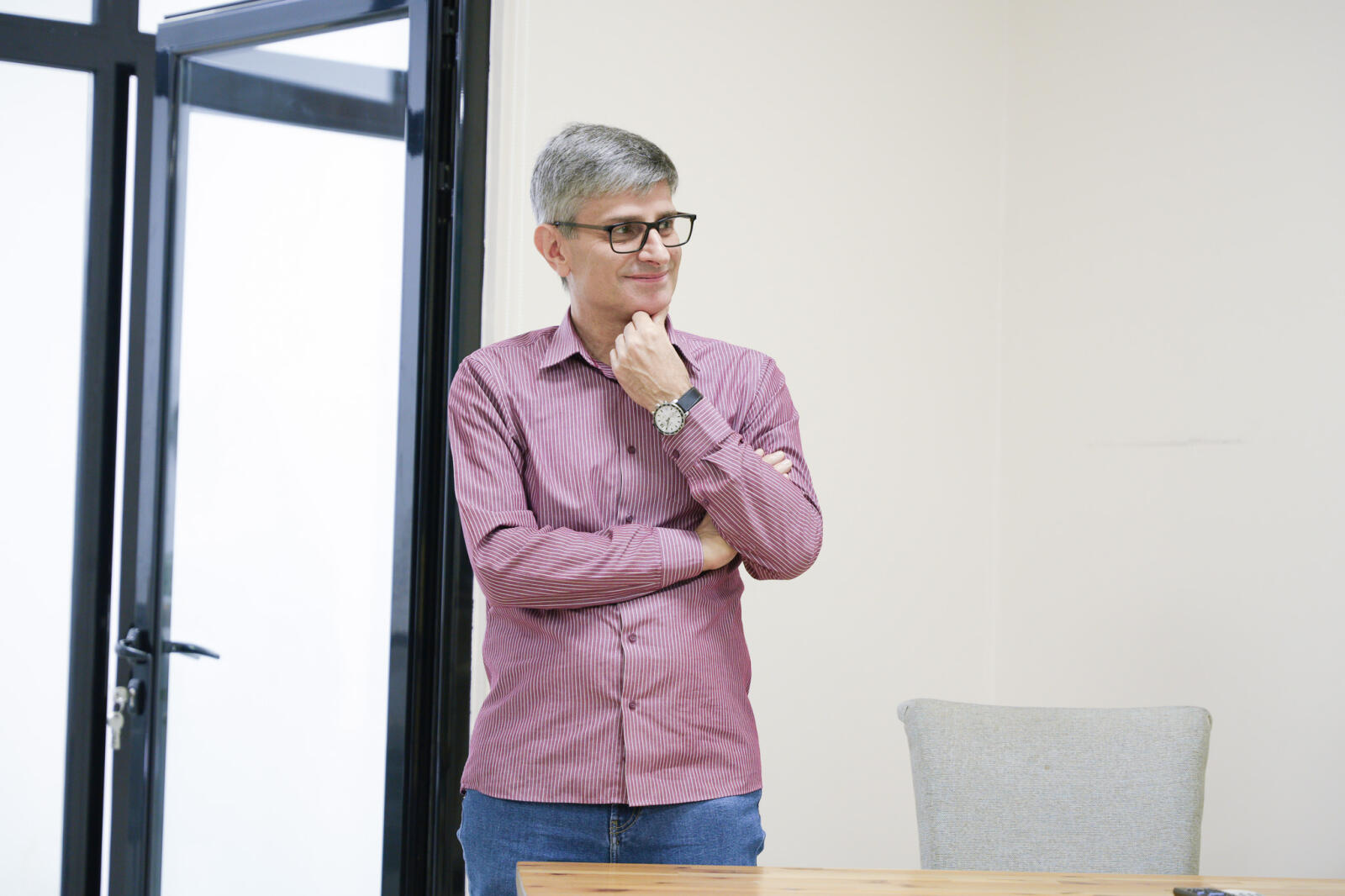
On the classroom wall at Hetq Media Factory in Yerevan, an instruction greets students: “Go and make your mistakes”.
At university, “it's 'Don't make any mistakes,'” according to the school's project manager, Harutyun Mansuryan.
On the day of EED’s visit, 16 new students are attending their first class in with Edik Baghdarasyan, Editor-in-Chief of Hetq, Hetq Media Factory’s parent organisation. They are the school's seventh generation of students, and they are beginning a month later than usual. The fact that they are here at all is a minor miracle.
In March 2025, US funding that had supported the school since it opened in 2019, ended in a single day. “They called us in the morning and they said: you can close the door and go home,” Harutyun recalls.
The team and instructors were determined to keep their school open and were prepared to teach for free, but their real obstacle was the rent.
It was then that they realised how valuable the work of the Hetq Media Factory had become within the Armenian civil society ecosystem. Organisations from across Armenian civil society began calling, asking how they could help.
“We realised the whole of civil society in Armenia was very worried about us. We were a source of high-quality journalists for them,” Harutyun says. He relates that in funding meetings, other independent media spoke up for them urging that they receive urgent funding.
Learning by doing
Hetq Media Factory is the only non-formal journalism school in Armenia, and it is completely free to attend. Its parent organisation, Hetq is one of Armenia's leading investigative outlets, a member of the OCCRP network, whose journalists have won many local and international awards.
Harutyun explains that university journalism in Armenia remains traditional, focused on lectures and theory, while the Media Factory takes the opposite approach. Students have access to top-of-the-range cameras, computers and hard drives, and every day they can go out, shoot and edit.
There’s significant demand to join the prestigious Hetq Media Factory programme. This year, 107 people answered the open call for selection, which ran over several stages culminating in a three-to-four-hour practical test. Students don’t even need to be studying journalism. “The main thing is their motivation. It does not matter how much they know,” he says.
To date, the school has trained 130 graduates, and around half work now in Armenian media or media-related organisations, including in Hetq, as journalists, editors, video editors and camera operators. Several are now teachers at the school.
One student's documentary, 1489, won first prize at the Amsterdam Documentary Festival and was recognised in the Los Angeles Festival. It tells the story of the director’s brother, who died in the Karabakh war six years ago. 1489 was the number on his remains.
While the school is filling an important gap in the country’s media sphere by providing high quality journalists and improving media ethics, Harutyun is most proud of the community of journalists it is creating.
“Almost every day graduates pass by to talk about their projects or to send me their new work,” he says. “They work together and they collaborate, no matter where they end up working.”
So What?
With EED support, the team launched “So What?”, a series of video stories in a solutions journalism format, produced by their graduates.
Harutyun explains that the format was a logical continuation of Hetq’s investigative work: “Every time we did a good piece of investigative journalism, nothing changed. We started asking So What? That gave us the name for this project.”
Each episode takes on one of Armenia's pressing problems, from issues like Yerevan's pavements, air pollution and traffic jams to radioactive waste from the nuclear power plant.
The first two episodes examined Armenia's drinking water, showing how fish farms in the Ararat Valley drew on the artesian basin without any metering. Harutyun notes that the topic was discussed at a senior government body, who recognised it as a major problem and urged more strategic use of artesian resources. Another senior official’s unofficial verdict was “Well done. The information you provide is excellent.”
Another So What? episode exposed how people in Armenia can buy a thesis, or even a PhD dissertation. The state body responsible for higher education and science shared it on its own channels.
Harutyun admits that the team assumed solutions journalism would be easier than investigative work, but it turned out to be harder.
“You have to go even deeper into the problem,” he says. “Then you have to find the solutions, which is even harder.” In each episode, they engage with specialists to help identify scientifically based and pragmatic solutions to the problems posed.
The films have proved highly popular. Initially planned at 15 minutes, this proved too short for the format, and they now run 22 to 25 minutes. All are professionally subtitled in English. Last year the team produced 22 episodes that were published on Hetq's website, YouTube and as shorter reels on Instagram.
Together they have drawn 4 million views, 40,000 likes, 10,000 shares and 2,500 comments. Even the longer films are watched an average of 8 minutes.
More than journalism
The school previously ran morning and afternoon shifts, with separate streams for multimedia and for research, covering data, investigative and financial journalism. Now there is a single shift, from 3 to 6pm. This year's seventh group of students will only study from October to December rather than the usual nine months, as funding will run out then. The team plans to travel to the US to raise funds from the Armenian diaspora over the next few months.
Despite the funding crisis, their ambition has not shrunk. They want to add new subjects, such as AI in journalism, and keep So What? in production. A second phase of the show is now being planned.
Harutyun believes the school’s alumni community has already changed the Armenian media. “If you ask editors-in-chief at different outlets, they'll say it has already changed something,” he says, continuing: “And we can change far more.”
He sees the school is about far more than just journalism. “People who study here become more responsible citizens,” he says.
This article reflects the views of the grantees featured and does not necessarily represent the official opinion of the EED.