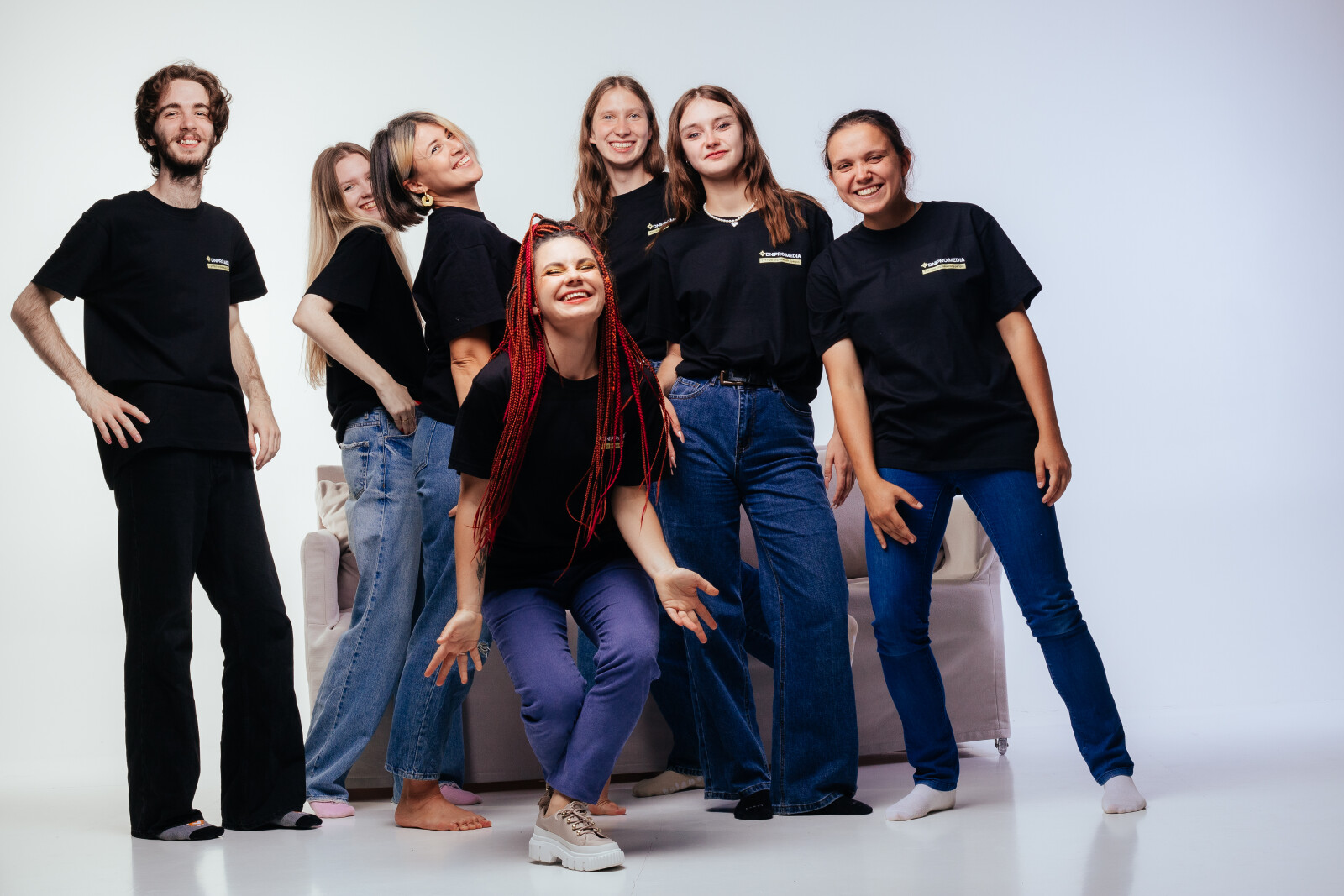
Anna Matviienko’s Dnipro.media is showing a city how power works – and how citizens can shape it
In 2022, Anna Matvienko was sitting in a glass-walled office in Berlin. It was the kind of place she had worked hard to reach: international team, senior role, polished conversations about growth and performance. She had built a career in tech, leading SEO teams, managing complex projects, moving confidently through the language of global business.
Outside, Europe was watching the war in Ukraine unfold, but inside, no one mentioned it.
“I realised I felt completely alone,” she says.
The war had already upended her country. But what unsettled her most in that moment was something quieter: the absence of urgency, of curiosity, of recognition. The sense that her reality, and the reality of millions of Ukrainians, had become distant, abstract.Within months, she returned to Ukraine.
Her husband made his own decision. With no prior military experience, he enlisted, and today, he works as a drone operator on the frontline. Anna chose a different form of defence.
A question no one was asking
Back in Dnipro, her home city, Anna began volunteering – raising funds, gathering supplies, trying to support the war effort in any way she could.
Then she came across a number that stopped her. Only 1% of the city’s budget was being spent on the military. “I thought it had to be fake,” she says.
Dnipro is not a marginal city. It is Ukraine’s third largest, a key industrial centre, and a critical humanitarian hub – receiving the wounded, the displaced, the aftermath of war from neighbouring regions under constant attack.
And yet, the allocation stood. “I checked again and again. It was true. And I couldn’t understand how that was possible.”
She began going to protests, asking questions, pressing local authorities, but access was limited and there was little transparency. The more she looked, the clearer it became that the problem ran deeper than one budget line.
Dnipro did not just lack answers. It lacked independent journalism.
Independent media was nearly absent, undermined by strong political influence. Many journalists had left for Kyiv, while local outlets were often tied to the city’s political leadership. In a city of over a million people, media was either politically aligned, commercially constrained, or simply absent. “If people don’t have information,” Anna says, “they don’t have power.”
Starting from nothing
She had never worked in a newsroom, but she knew how systems worked, and she knew how audiences grow. She had to build something from scratch.
Together with journalist and editor-in-chief Nika Yegorova, she launched Dnipro.media in 2024. It began, as many such ventures do, with two people and a spreadsheet.
The idea was simple and radical in its context: to create an independent platform that would explain how the city works and to hold it accountable. They started with something no one else was consistently covering – city council sessions, public procurement, budget decisions, the mechanics of local power. They translated bureaucratic language into something people could understand. They followed documents, cross-checked claims and built stories from primary sources.
And they showed up. “We decided we would attend every city council session,” Anna says. “Even if they didn’t want us there.”
Presence as pressure
Often, they didn’t. Dnipro.media journalists have faced repeated obstacles in entering official meetings in incidents that have been documented and raised with international watchdogs, but they have persisted.
Today, their journalists are regularly present inside those meetings. They report on how local deputies vote, what decisions are made, and how public money is spent, something that until recently, was largely invisible.
They are, in many cases, the only ones doing it, and their work has begun to ripple outward. National outlets have cited their reporting, and their investigations have been picked up across Ukraine and beyond.
But influence, for Anna, is not just about reach, it is about changing expectations.
“In Dnipro, people are not used to independent media,” she says. “They always ask: who is behind this? Who paid for it?”
Her answer is disarmingly simple. “No one. That’s the point.”
Building an audience
Dnipro.media does not look like traditional regional media. Its audience is young, often in their twenties and early thirties. Its tone moves between investigative reporting and accessible storytelling. Its distribution is as much Instagram and TikTok as it is a website.
“If you only write serious investigations, people won’t come,” Anna says. “You have to meet them where they are, and then bring them deeper.”
A street interview might lead to a policy explainer. A viral post might draw readers into a longer investigation. In less than a year, the platform has grown rapidly – reaching hundreds of thousands of views, building a loyal following, and beginning to form a core community of supporters.
They organise events, host discussions, experiment constantly. The goal is not just to inform, but to activate. “We call it: a polite way to make people act,” Anna explains.
Still, sustainability remains a challenge. Like many independent media initiatives in Ukraine, Dnipro.media operates in a fragile environment: limited funding, security risks and constant pressure.
At one point, the team went six months without external support, relying on personal funds to continue. Support from EED came at a critical moment, allowing them to rebuild the team, stabilise operations, and continue developing Dnipro.media as an independent platform.
“It gave us space to breathe again,” Anna explains. “We just couldn’t stop.”
In times of war
All of this unfolds under the constant pressure of war. Dnipro has recently seen intensified drone strikes, air raid sirens are constant, power cuts are frequent and staff. Families are divided between frontlines and home.
The newsroom is shaped by that reality. Journalists leave the country and others are mobilised, and hiring becomes harder. Every story is weighed up, not only for its importance, but for its impact in a fragile environment.
“There is always a balance,” she says. “You have to inform – but not create panic.”
Dnipro.media is still young, but in a city where independent journalism was almost non-existent, it has already begun to redraw the boundaries of what is possible through persistence, showing up and asking questions no one else is asking.
Asked who she considers a hero, Anna says: “Everyone who stays in Ukraine and does something for it.” Then she adds a name: her co-founder, Nika.
“She does all of this – and raises two young children,” Anna says. “I don’t know how.”
It is a small detail. But it captures something essential about the story. Because in the end, Dnipro.media is not just about journalism. It is about people who, in the middle of war, decide not only to endure but to build.
This article reflects the views of the grantees featured and does not necessarily represent the official opinion of the EED.
This initiative was supported thanks to the contribution of the European Union to EED.
This article includes an AI-generated audio version to offer readers an additional way to engage with the content. As the narration is produced using automated voice technology, occasional inaccuracies may occur.