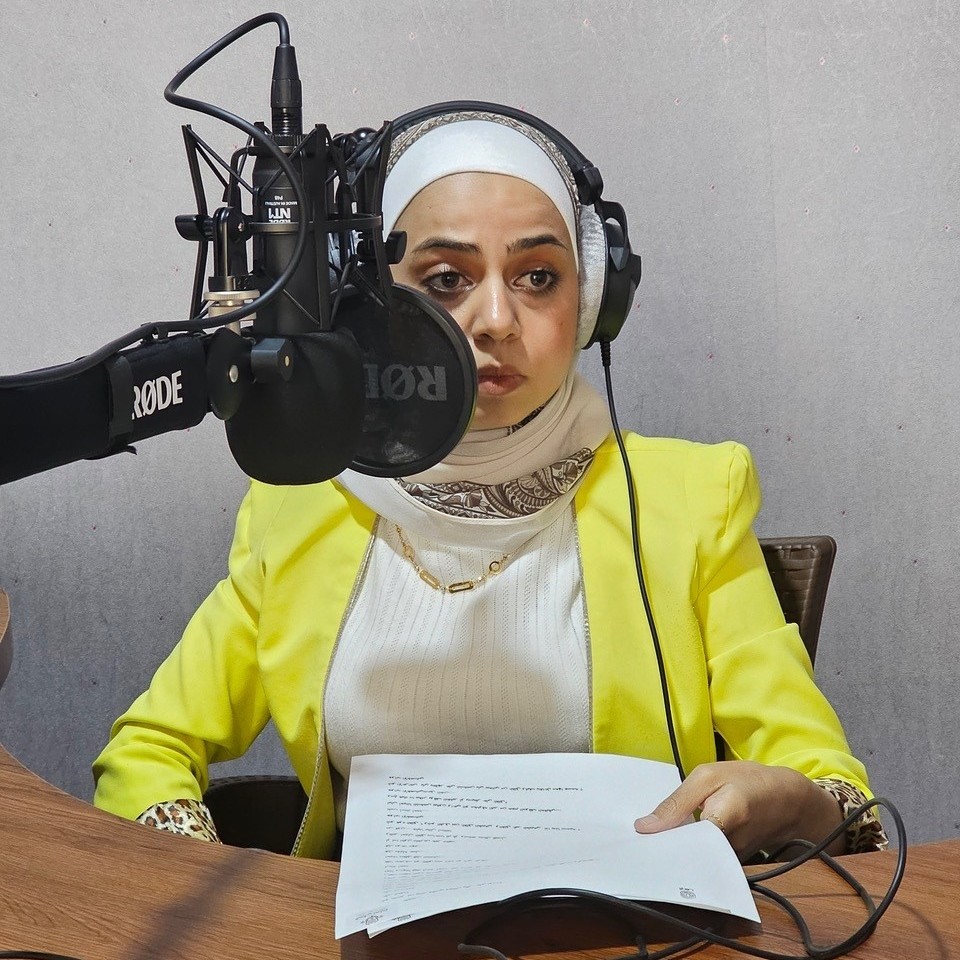
Athar Halab is a local radio station that seeks to help repair the social fabric in Aleppo that was torn to shreds by the Syrian war.
“You get the feeling that everyone in Aleppo wants to become a broadcaster just like everyone in Aleppo wants to become a singer,” says Syrian journalist, radio producer, writer and human and women’s rights activist Lenda Belal.
Lenda relates that over 60 people applied to join Athar Halab (Aleppo Impact), the new community radio station she has helped set up in Syria’s second city with EED support. Twenty have become broadcasters, and the others are now working on logistics, administration and other behind-the-scenes functions.
Athar Halab is the first local radio to be established in Aleppo. It was established by Athar Soria, a foundation dedicated to preserving and consolidating Syrian heritage and oral history, founded by Lenda and fellow journalist Jaber Baker, who is also a novelist, researcher and human rights activist.
As Lenda explains, Athar Halab functions as a broadcaster for and by locals that bridges the chasm in perceptions between Aleppo’s diverse communities and the divisions sowed by more than a dozen years of devastating conflict and war, which ended with the collapse of the Assad regime and the flight of former dictator Bashar al-Assad at the end of 2024.
Bridging narratives
The Syrian war left large swathes of Aleppo in ruins, killed tens of thousands of residents and displaced hundreds of thousands more. The conflict also deepened divisions and heightened distrust between areas in Aleppo that were under Assad regime control and areas that were under rebel control and were destroyed by the regime, as well as between Aleppo’s ethnically and religiously diverse communities.
“The difference in narratives between one area and another in Aleppo creates differences in worldview and the hardening of opinions,” explains Lenda. “Listening to the other sides’ narratives, and each side understanding what happened to the other sides, can help reduce the polarisation between all the groups in the city.”
Athar Halab is also spotlighting individual narratives because the conflict affected each person differently.
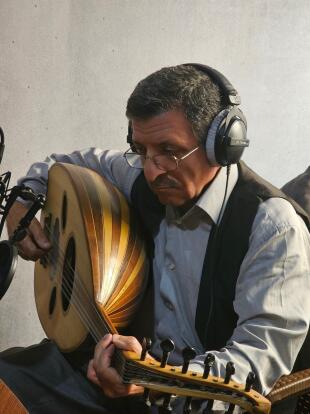
She explains that the long and bloody conflict corroded the sense of civic duty, pride and belonging Aleppoans used to feel towards their city and undermined the mutual trust they used to feel. “I find this is the biggest challenge, more so than rebuilding infrastructure and restoring utilities,” she observes.
Today, though Lenda senses a change in mood. “People are beginning to regain their sense of belonging and to think about their responsibilities and not just their rights,” she explains. She believes this is reflected in how people have been rushing to volunteer for Athar Halab, even though the work is unpaid while unemployment and poverty are high.
Pilot content
She relates that as Athar Halab’s recruits were radio novices, the first step was to train them up to create pilot content for the station.
One of the pilot programmes, produced by a young woman who is studying both pharmacy and politics, is a political talk show called Up for Discussion, which focuses on a different topic each episode and invites young people to be part of the conversation. Two pilot episodes of the show, which is set to air twice a month, have been produced.
Another young woman has been working on a programme about “sensory architecture” and building aesthetics in Aleppo. “I really like this programme because it plays on all the senses and helps raise appreciation for the beautiful architecture Aleppo is known for but which was devastated during the war,” notes Lenda. “We want the reconstruction efforts to pay attention to Aleppo’s original aesthetics, using the original stones where possible, and not rush to rebuild using inferior material like concrete.”
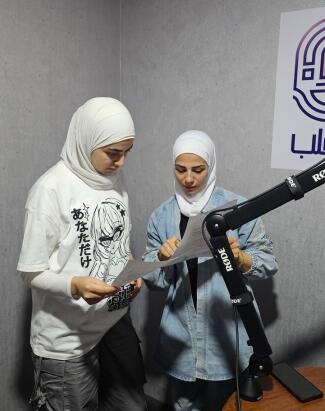
Other programmes focus on controversial topics using animal characters, the experiences of political prisoners and prisoners of conscience, and the trauma and other psychological issues caused by over a dozen years of warfare and decades of political repression.
Radio silence
Prior to the downfall of the Assad regime, the city’s airwaves, like elsewhere in Syria, were dominated by the regime and its allies in Iran and Lebanon. All these stations were taken off the air following Assad’s departure, leaving behind a temporary gap that Athar Halab is helping to fill. It is the first broadcaster targeting Aleppo in the post-Assad era.
Although the radio station is currently available only online, they intend to transmit on FM in 2027. To achieve this, they have been lobbying the Syrian authorities to put in place legislation for local radio, which currently does not exist.
Athar Soria also wants to replicate the Athar Halab experiment in other Syrian cities, not just Damascus but also smaller towns across the country.
Lenda sees this post-Assad fluidity as representing a window of opportunity to create a strong and robust civil society that can represent the interests of ordinary people and help hold the powerful to account. “Freedom of information and expression is a hard-won right. This transition period gives us a unique opportunity to build a ceiling above us as high as we can reach, while we still have the chance,” she says.
She sees media by the people and for the people as an essential building block of Syria’s future.
This article reflects the views of the grantees featured and does not necessarily represent the official opinion of EED.