How Rozafa Maliqi and her team keep one of Kosovo’s last public cinemas standing
On her first morning as director of Kino Armata, Rozafa Maliqi did not start by programming films or welcoming audiences in the foyer. Instead, she sat down to write an email explaining why the cinema should not be closed. The email was directed at the then-Secretary General of the Ministry of Internal Affairs, who has direct authority over buildings owned by the central government.
The agreement allowing the team to manage the building had suddenly been revoked. What should have been a brand new chapter became a race to prove that the space deserved to survive.
Community Roots
Rozafa describes herself first and foremost as a cultural worker. For more than fifteen years she has worked across Kosovo’s* independent cultural sector, contributing to festivals, initiatives, and community projects that often operate with limited resources but a strong sense of purpose. Over time, her interests increasingly gravitated towards questions of public space: who it belongs to, who maintains it, and what role it plays in shaping society.
That perspective made Kino Armata feel like a natural step.
The independent cinema space in central Prishtina, housed in a repurposed Yugoslav-era building, has become the place to be for film screenings, workshops, concerts, and community meetups since its opening in 2018. It’s one of the city’s rarely accessible cultural commons, where students, artists, activists, parents and neighbours can share the same room.
When the opportunity arose in summer 2024 to lead Kino Armata, Rozafa saw it as a chance to help develop a space that already held deep meaning for the local community. She did not expect that stabilising the institution would immediately become her main job.
Critical Connections
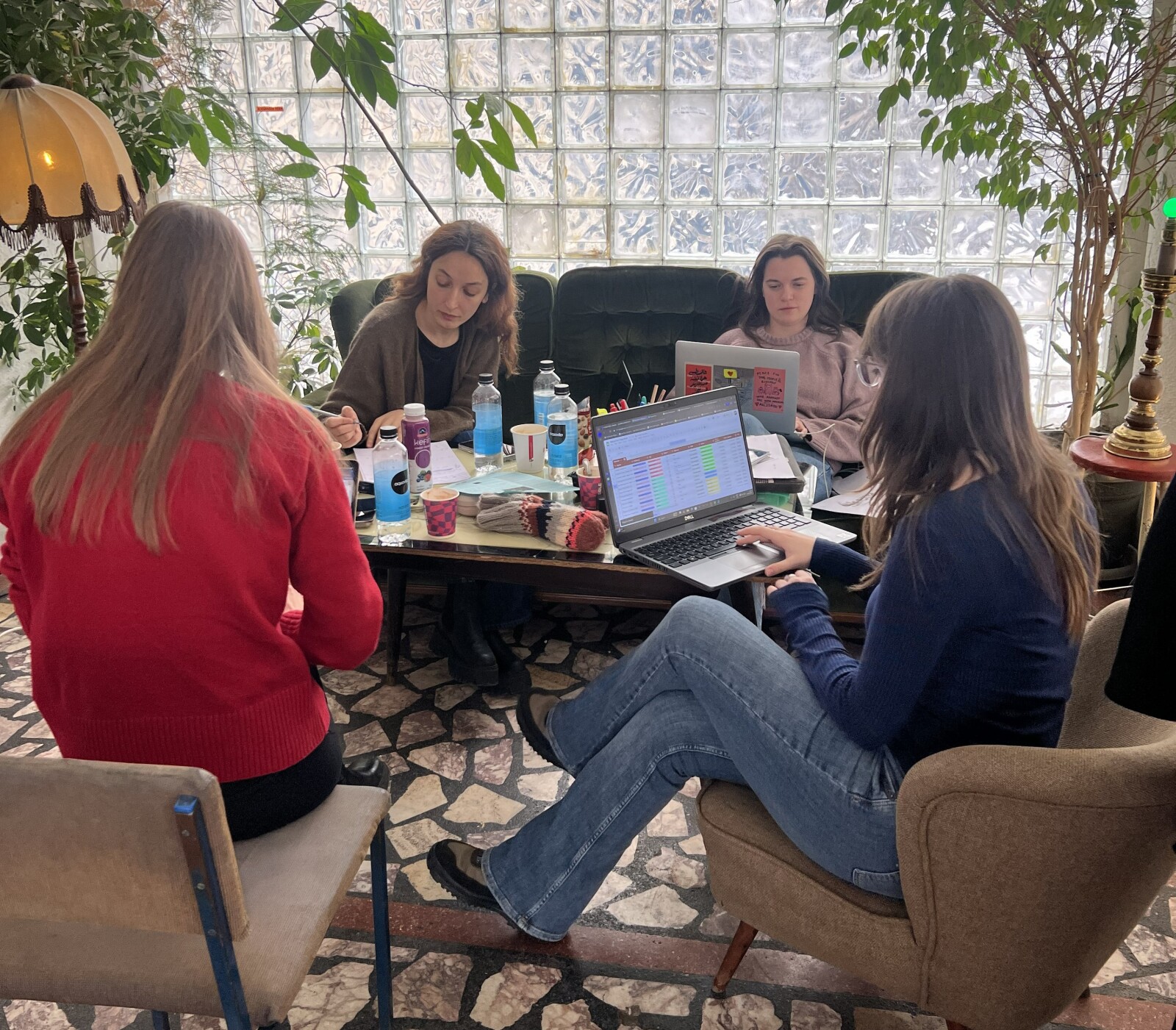
Despite the uncertainty, the small team - now five people - has pushed to keep the cinema active and visible. Maintaining a steady programme has been both a cultural mission and a strategic necessity: activity demonstrates relevance, and relevance helps secure support.
Recent months have included collaborations with the National Film Archive of Albania, screenings tied to the European Film Academy awards season, and partnerships aimed at bringing contemporary European films to Prishtina audiences who might otherwise struggle to access them. These initiatives not only broaden the programme but reinforce Kino Armata’s role as a bridge between local viewers and wider regional and European film cultures.
Rozafa’s proudest achievement is simpler. A year ago, with almost no funding, the team revived the cinema’s film club, Kineto.
It began as a practical idea: weekly gatherings where participants propose films, vote collectively, and watch them together.
Today, the club continues to meet, attracting a core group of around 10 to 20 active members, with many more following discussions online. For Maliqi, its importance goes beyond simply watching movies together.
“The space creates a feeling of community,” she says. “Kineto shows that the space can move on its own.”
That outreach matters. Even in the city centre, visitors still walk in surprised to discover the cinema exists.
Foundational Features
She emphasises that spaces like Kino Armata do more than screen films. They are also places where people can meet, discuss, debate and connect outside mainstream institutional settings. This is especially important in a context where polarisation and diminishing public space make this a harder task.
For Rozafa, this civic dimension is central. Last year, when the cinema’s legal status became uncertain, the team chose to make the struggle public, contributing to a wider conversation about the future of community-managed public spaces.
“It’s not just about us,” she says. “It’s about building infrastructure that supports independent initiatives, things the government alone cannot do, and the private sector won’t prioritise.”
She also sees the cinema as part of a regional network. Increasingly, the team connects with activists and cultural organisers across Serbia, Greece, North Macedonia, and Bosnia and Herzegovina, hoping to turn the space into a hub of solidarity.
Critical Cuts
Kino Armata operates in a Kosovo that is itself evolving. After the war and independence, a wave of funding helped build a strong civil society, but as funding has disappeared, organisations have had to rethink how to sustain their work.
Community work, Maliqi notes, rarely fits neatly into rigid funding structures. Plans often change. Unexpected challenges appear. Much of the labour goes into building the conditions that make cultural work possible in the first place.
That is why operational support can be decisive.
Recent backing from EED allowed Kino Armata to secure film rights, expand its programme, and demonstrate what the new team can achieve when the basics are covered.
“It gave us the chance to show what we want this space to be,” Rozafa says. “And once people see that, doors start opening.”
A Different Future
For now, the team’s priorities remain pragmatic. They want to stabilise funding streams, strengthen partnerships, expand outreach, and work toward a long-term agreement that secures the venue’s future.
Rozafa's hopes for Kosovo extend beyond the cinema itself. “I think we urgently need to broaden our imagination,” she says.
Too often, she feels, the country’s cultural and political energy is directed outward - toward international recognition, external perceptions, or meeting the expectations of others. While those goals matter, that outward focus can leave less room to create culture and institutions rooted in local audiences and forms of belonging.
“Are we creating for ourselves?” she asks. “Or for how we want to be seen?”
For her, spaces like Kino Armata offer a place where those questions can be explored collectively, not only through formal discussions but through the everyday practice of gathering, watching, debating, and sharing a room.
As she sees it, sometimes defending democracy does not begin with grand gestures or sweeping reforms. Sometimes it begins with something much simpler, and much harder: Keeping the doors open.
* This designation is without prejudice to positions on status, and is in line with UNSC 1244 and the ICJ Opinion on the Kosovo Declaration of Independence.
This article reflects the views of the grantees featured and does not necessarily represent the official opinion of the EED.
This article includes an AI-generated audio version to offer readers an additional way to engage with the content. As the narration is produced using automated voice technology, occasional inaccuracies may occur.