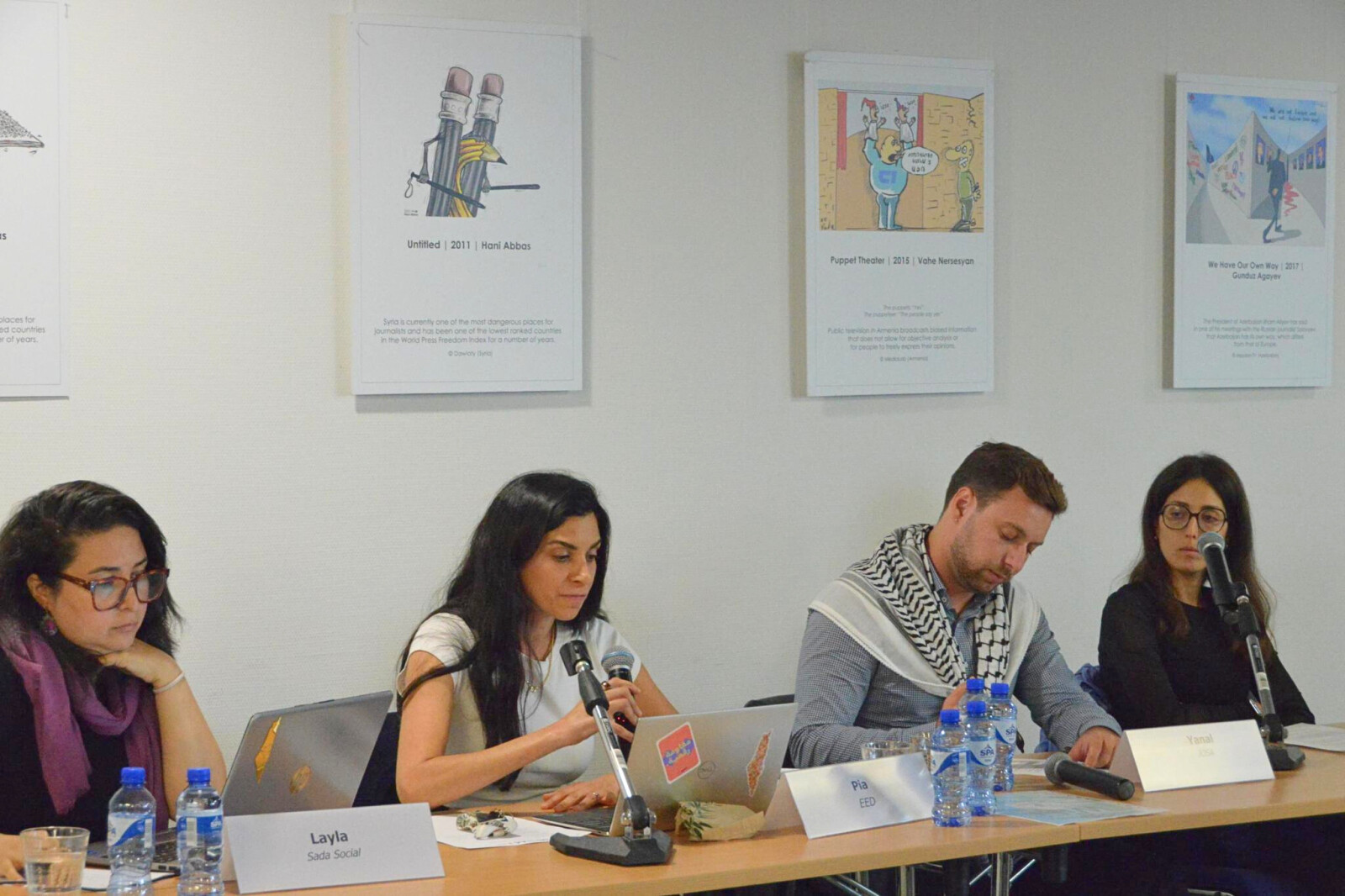
On 25 September 2025, the European Endowment for Democracy and International Media Support convened a critical dialogue on digital rights in the Middle East and North Africa (MENA) region, bringing together civil society organisations working at the frontlines of platform accountability with EU policymakers and international stakeholders.
The event showcased how organisations like 7amleh, Sada Social, and the Jordan Open-Source Association (JOSA) are developing innovative AI-powered tools to document digital rights violations while highlighting an urgent reality: the protections enshrined in EU regulations like the Digital Services Act (DSA) and AI Act rarely extend to users in the Global South, despite the same companies and technologies operating worldwide.
From Documentation to Defence of Life
Panellists noted how digital rights work in conflict zones has evolved beyond technical monitoring into a matter of survival. Layla Samara from Sada Social described how documenting content removal policies against Palestinian voices became an exercise in creating alternative archives to prevent narrative erasure. This work influences platform policies and serves as evidence before European and UN bodies, demonstrating that algorithmic censorship is not merely a technical error but a systematic form of oppression.
Following 7 October 2023, as Israel imposed communication blackouts in Gaza, Sada Social's mission expanded dramatically, as they established emergency hotlines for the 241 journalists killed by Israel, organised radio broadcasts to share life-saving information about rescue services and food supplies, and coordinated ground operations when digital tools failed.
"We are defending the right to life itself, using technology as a tool to resist blackouts and killing," Samara said, underscoring that digital rights are fundamentally inseparable from physical survival.
This transnational dimension requires responses beyond consumer protection frameworks. Samara pointed to credible evidence of AI systems like Lavender being weaponised in conflict, high-tech companies exporting surveillance tools without accountability, and the development of autonomous weapons systems with applications far beyond the Middle East. She noted that foreign policy measures, including sanctions against companies that facilitate human rights violations through their technologies, are essential.
Systemic Platform Discrimination and the Evidence Base
Taysir Mathlouthi from 7amleh presented compelling data on Meta's systematic discrimination. The 7or Observatory documented 3,576 digital rights violations in 2024, supported over 8,000 individuals, and restored 566 accounts unfairly targeted by over-moderation of Arabic content. 7amleh's Violence Indicator - an AI classifier operating in Hebrew and Arabic - flagged over 13 million violent posts, predominantly in Hebrew, that remain online with little consequence.
This disparity is embedded in platform policies; Meta made specific policy changes after the war erupted in Gaza that disproportionately affect Palestinian and pro-Palestinian expression while allowing Hebrew hate speech targeting Palestinians to proliferate unchecked.
While DSA implementation demands increased content moderation within EU borders, platforms have cut staff in other regions, effectively reducing accountability elsewhere. Mathlouthi noted that DSA is being weaponised to target pro-Palestinian content within Europe itself, revealing fundamental gaps in how "harmful content" is defined and applied.
Mathlouthi highlighted that while EU regulations focus on Russian and Chinese disinformation, they ignore Israeli military spending, which amounts to millions of euros on ads targeting European audiences with content that, in other contexts, would constitute incitement. Google's advertising policies similarly allow Israel's Ministry of Defence to run campaigns calling for ethnic cleansing of Palestine, employing Cambridge Analytica-style microtargeting.
Mathlouthi stated that this lack of consistent application extends to corporate complicity. EU due diligence mechanisms are challenged in many contexts. 7amleh calls for formal inclusion of MENA civil society in EU consultation processes and policy implementation reviews, mandatory corporate human rights due diligence on digital activities outside the EU, and transparent reporting on content moderation practices across all markets.
Open-Source Solutions and Regional Adaptation
Yanal Qushair from JOSA demonstrated a different model of resistance through the Nuha tool, an AI-powered classifier detecting online gender-based violence in various Arabic dialects. The tool was successful in documenting a hate campaign against Jordanian human rights lawyer Hala Ahed, revealing that her phone was infected with Israeli spyware, Pegasus, which led to concrete policy recommendations developed with local organisations.
Qushair noted that machine learning applications remain overwhelmingly English-dominant, with Arabic among the most underrepresented languages. JOSA's expansion to Egyptian and Iraqi contexts demonstrates both the necessity of cultural specificity and the potential for regional scaling.
Yet Qushair expressed scepticism about corporate accountability, noting that large corporations use open-source technologies without contributing back to the community, extracting value while avoiding responsibility, and recommended that the shift toward open-source infrastructure must be accompanied by governmental bodies taking responsibility for regulation. Platforms will not voluntarily prioritise people over profit.
"Rather than desperately trying to patch up the leaks in our societal fabric, serious economic and political reform is the only way to mitigate the socially regressive currents that still plague our world."
Platform Dynamics and AI Challenges
The discussion revealed distinct platform behaviours. X provides relatively unmoderated space - both blessing and curse. Meta systematically silences Palestinian voices. TikTok demonstrates more responsiveness, though gaps remain. Google presents challenges around monetisation of harmful content. Telegram hosts dangerous rhetoric with little response to violation reports.
Panelists noted that online gender-based violence serves as a go-to tool for authoritarian actors. Saudi Arabia, UAE, and Egypt deploy coordinated disinformation campaigns, with the first two countries second only to China in distributing disinformation on X through networks of automated bots.
The proliferation of AI-generated content compounds detection challenges. Mathlouthi argued for harder regulation and emphasized that MENA civil society organisations should maintain sovereignty over AI development and data centres rather than depending on external infrastructure.
Recommendations:
1. Uniform Global Application of EU Digital Regulations: The EU should require tech companies to implement DSA and AI Act protections uniformly across all markets worldwide, with transparent reporting and meaningful penalties for violations.
2. Mandatory Corporate Human Rights Due Diligence: Implement enforceable corporate human rights due diligence obligations for digital activities outside the EU, backed by foreign policy tools including sanctions against companies whose technologies facilitate human rights violations.
3. Formal Inclusion of MENA Civil Society in EU Policymaking: Establish mechanisms for meaningful participation of MENA civil society organisations in EU consultations, policy evaluations, and implementation reviews through formal structures like the Civil Society Facility for the Mediterranean.
4. Sustained Funding for Digital Rights Infrastructure: Shift from project-based grants to sustained, long-term funding for monitoring infrastructure and open-source solutions that recognises digital rights defence as ongoing work requiring stability.