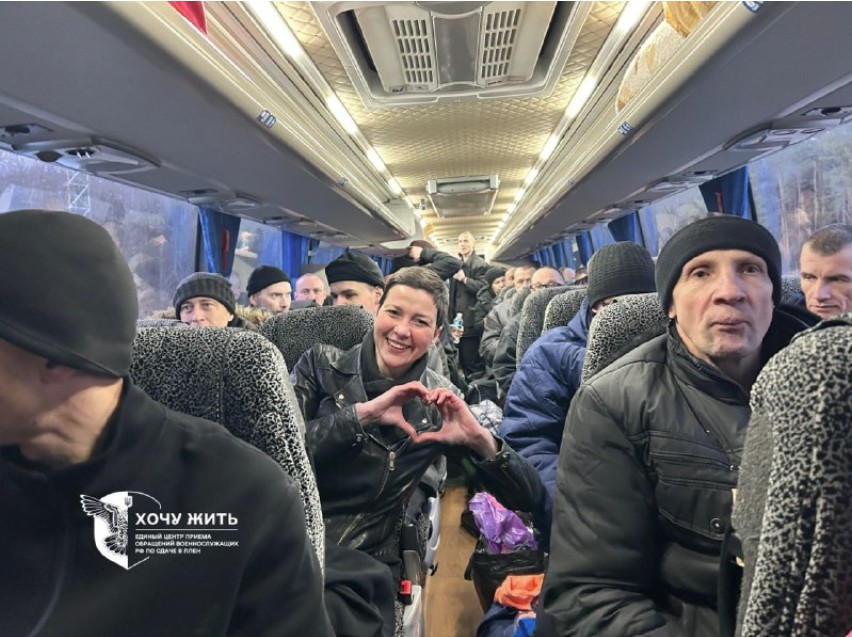
Cover Photo: © Проект «Хочу жить»
With EED’s backing, access to independent information and civic engagement is preserved inside Belarus, while democratic leadership in exile remains relevant in international advocacy
Belarus is a country where space for independent political, civic and media activity has been systematically restricted. Independent organisations have been liquidated, media declared extremist, civic activity criminalised, and the opposition has been forced into exile. Inside the country, fear, surveillance and repression hamper the space for collective action.
Continuously supported by EED, independent media, civic networks and political actors in exile have managed to operate under these conditions. Inside Belarus, access to independent information and some grassroots civic engagement has been preserved. Outside the country, democratic opposition structures have focused on international advocacy and preparing alternative governance structures.
While power was not won in 2020, when mass protests followed a widely disputed presidential election, “something changed in society. People learned to organise, to trust one another, and to act.”
A CLOSED CIVIC SPACE IN A CLOSED COUNTRY
Since the mass protests of 2020, Belarus has experienced a significant tightening of authoritarian control. What had long been a highly constrained political environment became markedly harsher and more comprehensive in its repression.
As one observer put it, “before 2020, everything was already controlled – but there was still some space at the margins. After 2020, that space disappeared.”
Independent organisations were dismantled, media outlets banned, thousands detained and tens of thousands forced into exile. Civic activity that once operated in informal or tolerated spaces was increasingly criminalised. “Now even neutral civic activity can be treated as a crime,” one actor noted. “It doesn’t have to be political anymore.”
The external environment has also become more difficult. Belarus has become increasingly involved in Russia’s war of aggression against Ukraine, including through the use of its territory and logistical infrastructure. This alignment has narrowed international engagement on Belarus as attention has shifted to other crises, while repression inside the country has intensified daily pressures on citizens.
Many organisations experienced repeated displacement. “A lot of us had to move twice,” one organisation recalled, “first because of repression in Belarus, and then again because of the Russian war in Ukraine.”
Inside the country, repression has produced atomisation rather than mobilisation. “People are not mobilised anymore – they are trying to survive,” one observer said. “The system is built to isolate people from one another. Collective action is what it fears most.”
In this context, civic engagement persists only through alternative channels — information flows, trusted networks and forms of organisation that operate beyond the reach of the state.
ACCESS TO INFORMATION, CIVIC ENGAGEMENT AND VOICE ABROAD
EED support in Belarus since 2020 has focused on supporting key pro-democracy and civil society actors to maintain their activities, despite ongoing repression and a challenging funding environment. This includes supporting activities that inspire activism and citizen engagement, including those that foster ties between exiled and in-country activists; ensuring access to objective information for citizens through diverse independent media; and supporting activities in sensitive areas where other donors cannot intervene. This has meant focusing on sustaining three interconnected areas: independent information channels reaching people inside the country; democratic structures in exile that protect the interests of Belarusians through services and international advocacy; and networks of civic engagement and support that remain relevant to everyday life under repression.
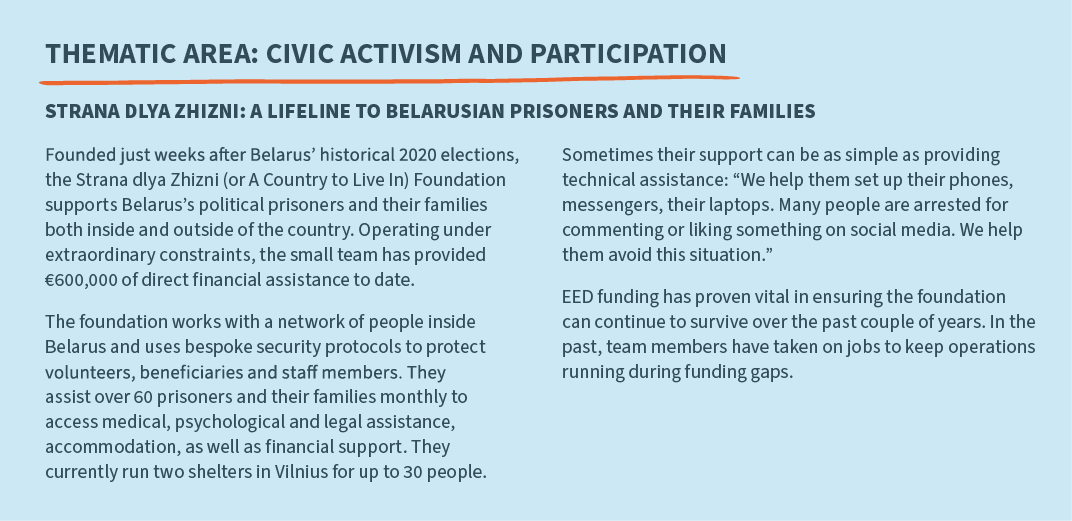
Sustained support for independent Belarusian media forced into exile enabled newsrooms to continue operating after relocation and to adapt to an increasingly hostile information environment. Media actors describe EED support as allowing them to retain core editorial staff, invest in new formats and maintain multi-platform distribution strategies at a moment when visibility inside Belarus was at risk. As one editor put it, “the real challenge was not regaining the audience, but staying relevant year after year.”
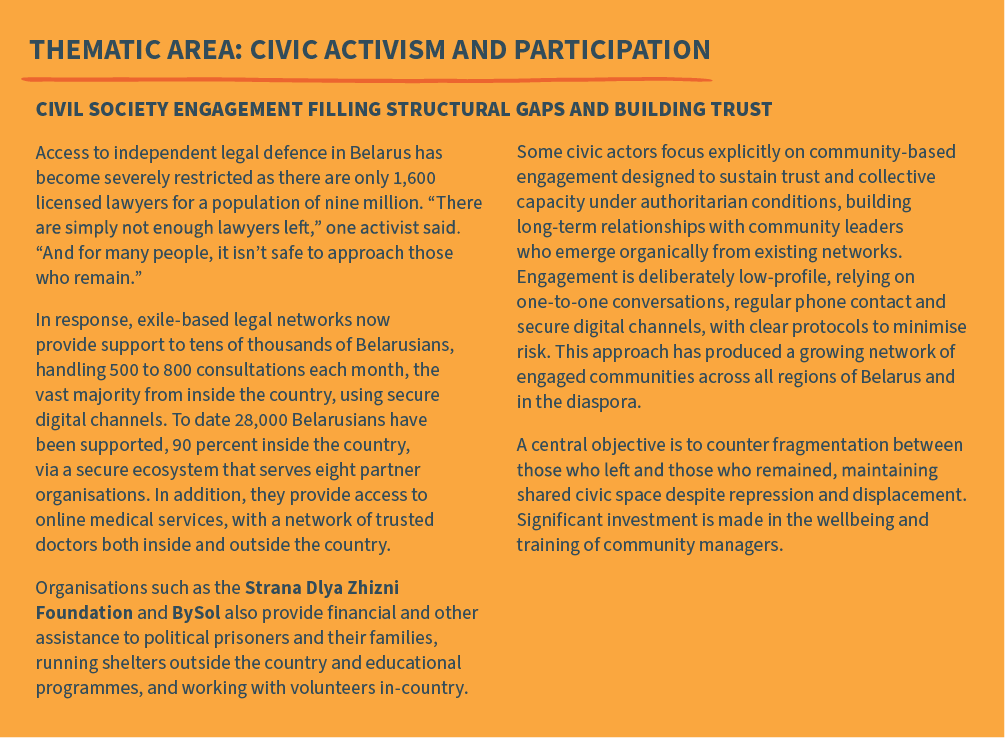
EED support has also underpinned networks that allow sustained engagement with citizens inside Belarus, particularly through legal, medical and humanitarian channels. These networks operate largely through secure digital platforms and rely on continuity and trust rather than visibility. With EED assistance, these platforms are preserving civic connection, trust, and mutual support under conditions of repression.
Finally, EED support has contributed to sustaining democratic opposition structures in exile focused on international advocacy, coordination and preparedness. This has included support to building the opposition governance structure in exile. Belarusian democratic actors have become recognised interlocutors internationally, while maintaining channels of connection with people inside the country.
As one partner summed it up, “there is now an ecosystem – political actors, civil society, media, diaspora initiatives – that didn’t exist in this form before.”
Partners also highlight the flexibility of EED’s approach. “When funding is tied too closely to specific activities, it leaves very little room to adapt,” one organisation explained. “But adaptation is exactly what we need in this context.”
This approach proved particularly important in 2025, when the abrupt withdrawal of major US funding created uncertainty across the sector. Organisations were forced to reassess staffing and programming, and some reduced activities. As several actors put it, “it was a big hit.” Flexible EED support helped stabilise core capacity and avoid abrupt disruptions. “Without that support,” one organisation said, “we would have had to limit our activities significantly.”
THREE INTERLOCKING PATHWAYS
Independent media have repeatedly demonstrated the ability to re-establish operations, regain domestic audiences and sustain engagement over time, even under conditions where other civic and political actors face far greater obstacles to in-country reach.
Editors recall the period after relocation as a race against invisibility. “The biggest fear was simply disappearing,” one said. “People inside Belarus found us again very quickly – faster than we expected,” says another.
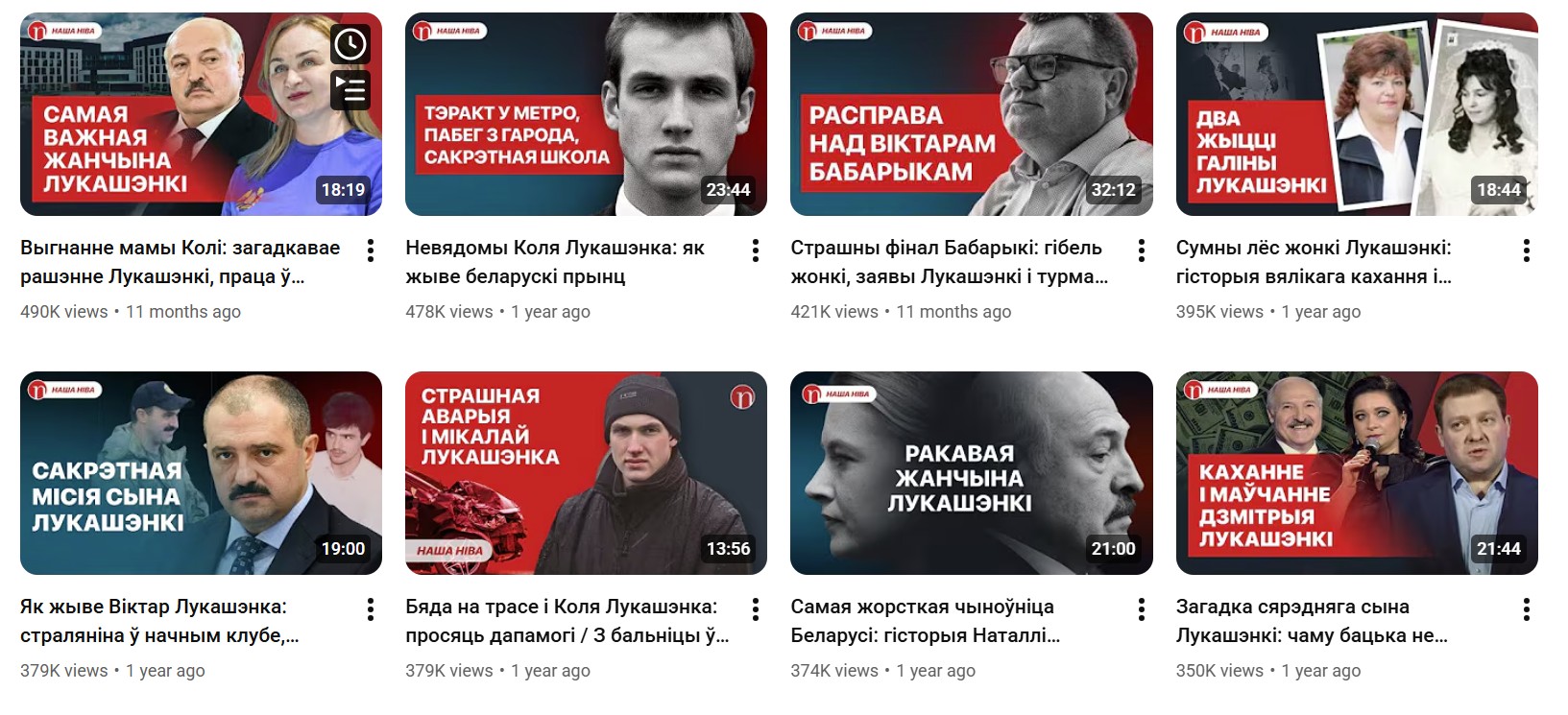
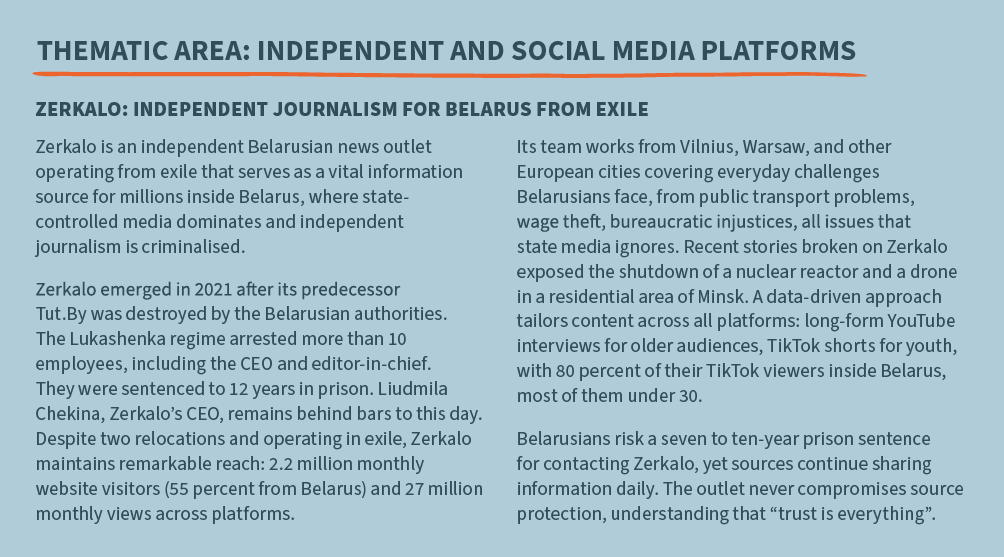
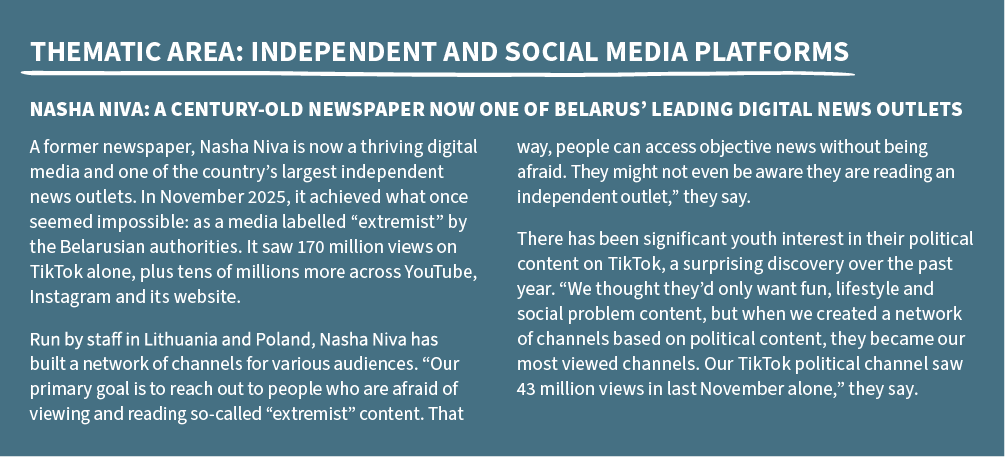
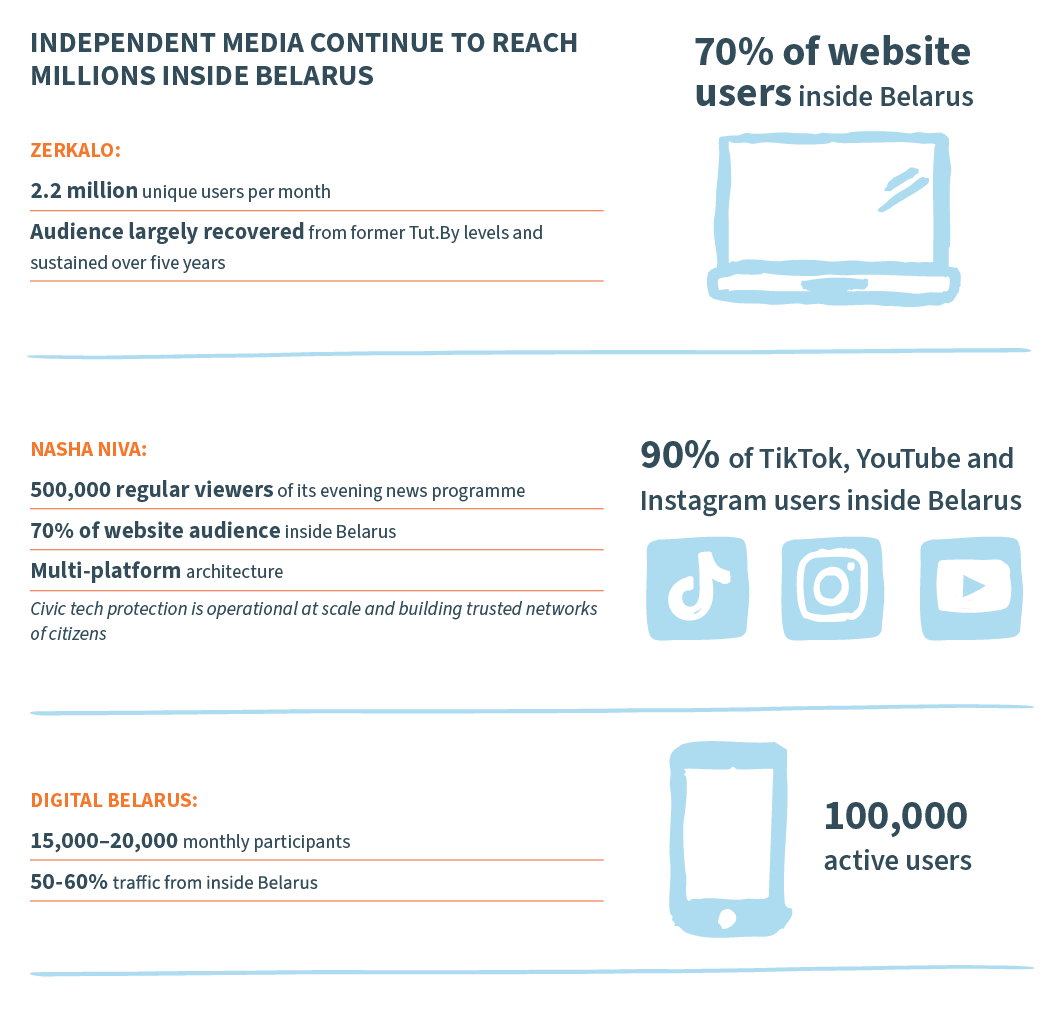
Today, outlets such as Zerkalo, Nasha Niva, Malenka Media, Epramova and Budzma reach millions of users each month, with more than half of their audience consistently inside Belarus. Short-form video is particularly important: editors report that the vast majority of their TikTok audiences are based in-country. This sustained reach reflects a deliberate multi-platform strategy, combining websites, apps, social media and parallel channels designed to bypass censorship.
Having rebuilt operations in exile and regained audiences inside Belarus, the focus is now on sustaining infrastructure, formats and coordination over time. “Our task now is to preserve what we have,” one editor explained, “so that if change begins, our starting position is stronger today than it was in 2020.” Several contrasted the current landscape with the period before the protests, noting that key digital platforms barely existed at the time. “In 2020, Belarusian YouTube didn’t really exist,” one actor said. “Now we have a big infrastructure, and I’m sure that if critical changes happen, we won’t start from zero but from floor 10, we’ll go higher.”
Independent analysts consistently describe this outcome as a major success. Exiled Belarusian media have retained large, stable domestic audiences and, on several platforms, outperform state propaganda in reach and engagement. In a media environment designed to isolate and exhaust independent voices, this sustained presence inside the country remains one of the clearest indicators that independent information channels have not been broken.
Civic actors working from exile emphasise that their relevance depends on remaining connected to everyday life inside Belarus. Rather than framing their work as service provision alone, they describe it as maintaining trusted networks through which people can engage and seek information, advice and support safely.
Legal, medical and humanitarian support operate as entry points into these networks. Civic organisations stress that what matters most is continuity. “Once you stop, even for a short time, people assume you are gone,” one noted. “And then it’s very difficult to come back.”
Several actors linked this continuity to democratic relevance in more indirect terms. Open mobilisation is not possible under current conditions, but maintaining contact allows information to circulate, relationships to persist and trust to be preserved.
In this context, sustained civic engagement functions as a form of preparedness. While few spoke explicitly about future mobilisation, several emphasised that without these networks and relationships, democratic capacity would be difficult to reconstitute if conditions change. “Without these structures,” one actor said, “there would be nothing to return to."
Following the 2020 protests, the leadership of Belarus’s democratic opposition was forced into exile. Those involved describe the initial phase as reactive rather than planned. “We didn’t move into exile with a strategy,” one senior figure recalled. “We were reacting to repression, trying to keep things together.” Over time, however, the opposition consolidated into political structures capable of representation, coordination and agenda-setting outside the country.
At the centre of this effort is the Office of Sviatlana Tsikhanouskaya, alongside the United Transitional Cabinet and the Coordination Council – bodies that together provide political coordination, representation and continuity for the democratic opposition in exile. They have become recognised interlocutors in international discussions on Belarus. Opposition representatives now engage regularly with EU institutions, European governments and parliamentary bodies, contributing to deliberations on sanctions policy, international accountability mechanisms and future transition scenarios.
This international engagement has translated into concrete outcomes. Opposition representatives were involved in sustained diplomatic engagement around several waves of political prisoner releases in 2024 and 2025. Those involved are careful not to overstate their role, but they describe such moments as evidence that coordinated advocacy can still have impact under highly constrained conditions.
At the same time, the limits of political action are clearly acknowledged. “It is very difficult to be active inside the country,” one representative noted. “If there are arrests, we are blamed for calling people to resist.” As a result, political mobilisation inside Belarus remains indirect and highly constrained. The emphasis instead is on preserving political capacity and institutional continuity. “We cannot plan far ahead, the context doesn’t allow it,” one actor said. “But without these structures, there would be nothing to return to.”
Political, civic and media actors, alongside a rapidly growing diaspora, have gradually assembled a form of democratic scaffolding in exile. As one partner put it: “There is now an ecosystem – political actors, civil society, media, diaspora initiatives – that didn’t exist in this form before.”
For those involved, this ecosystem is less about immediate political change than about preserving democratic capacity under repression. Several actors described this as maintaining a basis for future democratic renewal – so that when political conditions shift, there are institutions, networks and practices capable of taking action and responsibility.
A defining feature of this ecosystem is the role of civil tech in holding it together. Belarus entered the crisis with a highly developed IT sector, and repression redirected this expertise into democratic work.
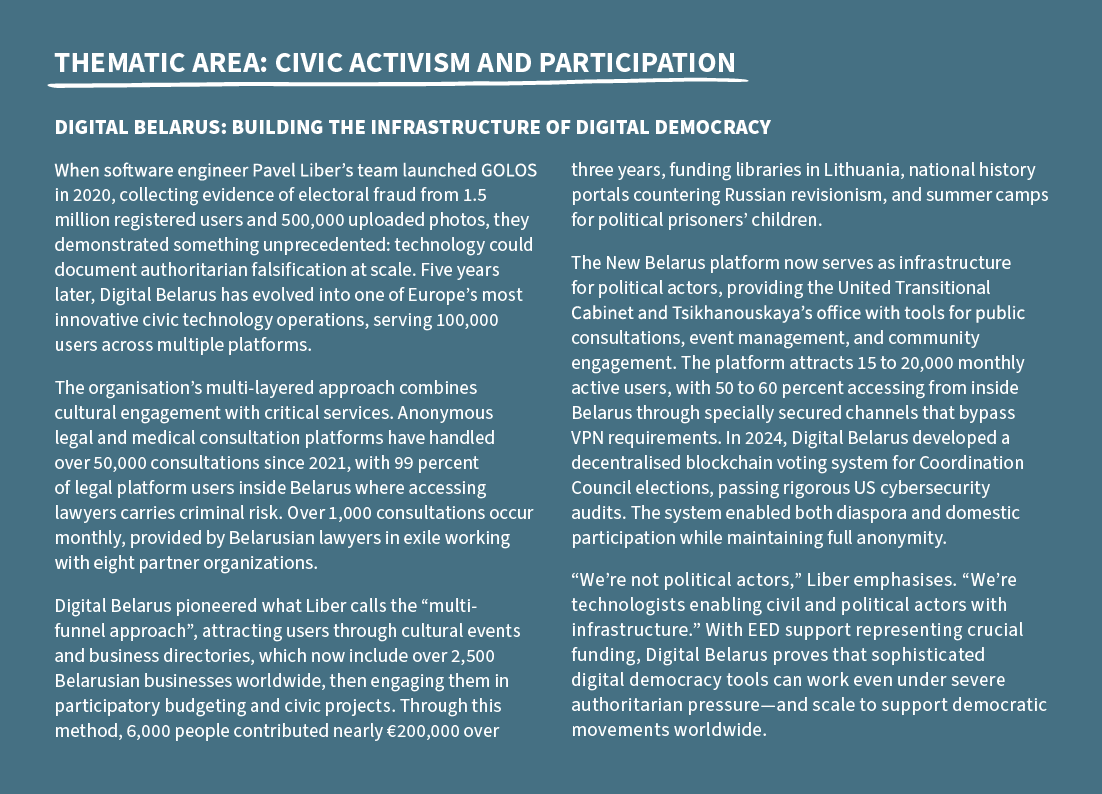
“I was never involved in politics before,” says Pavel Liber, founder and director of Digital Belarus. “I was building complex digital platforms for business. Now I do the same work – but for civil society.”
The maturity of this capacity is reflected in scale as well as design. During the 2020 elections, when independent and credible international observation was banned by the Lukashenka regime, digital platforms enabled 1.5 million people to register and submit information on electoral wrongdoings. Around half a million ballot images were uploaded, creating a credible, data-driven challenge to official results.
Similar tools have supported other Belarusian organisations, enabling tens of thousands of legal and medical consultations for repressed individuals, with developers noting that the overwhelming majority of users connect from inside Belarus. As one partner explained, “we are not replacing civil society – we are giving them the tools they need to keep working.”
Civic tech now underpins much of the ecosystem’s activity: media distribution, legal and medical consultations, humanitarian coordination and civic participation. Importantly, this infrastructure is collaborative. “We build tools so others can do their work,” Liber explained. “Almost everything depends on these platforms now – they connect media, lawyers, volunteers and political actors.”
The continued functioning of independent media, civic networks and political structures in exile has strategic relevance for both Belarus and Europe.
These actors preserve access to independent information for people inside Belarus, sustain civic trust and coordination under repression, and maintain alternative representation at the international level. Together, they ensure that democratic capacity is not erased, even when it cannot operate openly.
When political conditions eventually shift, the presence of functioning media, trusted civic networks and internationally recognised political actors will shape the scope, credibility and speed of any future transition.
By sustaining these capacities over time, Europe helps ensure that democratic renewal in Belarus, when possible, can build on existing institutions and social trust rather than starting from scratch.
This article includes an AI-generated audio version to offer readers an additional way to engage with the content. As the narration is produced using automated voice technology, occasional inaccuracies may occur.